


What's Happening?
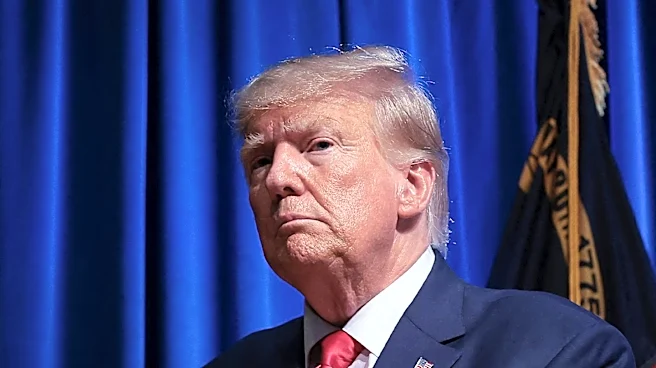
President Trump has utilized artificial intelligence (AI) to create and disseminate videos mocking his critics, including Academy Award winner Whoopi Goldberg and actor Robert De Niro. On July 2, President Trump released an AI-generated video portraying
himself as a doctor offering a 'Trump Derangement Syndrome' treatment to celebrities who have criticized his administration. This video featured AI-generated likenesses of Rosie O’Donnell, Whoopi Goldberg, Julia Roberts, and Robert De Niro, depicting them as suffering from the 'syndrome.' More recently, President Trump posted an AI-fabricated image of Robert De Niro wearing a shirt that read 'Donald Trump is my president' on his social media platform, Truth, accompanied by a caption ridiculing the actor. This is not the first instance of President Trump using AI to target De Niro, whose criticisms of the former president date back to his first presidential victory in 2016. De Niro has consistently voiced strong opposition to President Trump, including calling him 'the enemy of the country' and urging the public not to vote for him in upcoming elections.
Why It's Important?
The use of AI by a prominent political figure like President Trump to create and spread satirical or misleading content about opponents raises significant concerns regarding the integrity of public discourse and the potential for misinformation. This practice can blur the lines between reality and fabrication, making it increasingly difficult for the public to discern authentic information from AI-generated content. For public figures like Whoopi Goldberg and Robert De Niro, being targeted by such AI-generated content can impact their public image and potentially incite negative reactions from supporters of President Trump. This trend also highlights the growing challenge of regulating AI technology in political campaigns, especially concerning its capacity to generate deepfakes and other forms of synthetic media. The implications extend to the broader media landscape, where the proliferation of AI-generated content could erode trust in traditional news sources and contribute to a more polarized information environment. The ease with which such content can be produced and shared underscores the urgent need for discussions around ethical AI use and digital literacy.
What's Next?
The continued use of AI-generated content in political discourse is likely to intensify, particularly as the technology becomes more sophisticated and accessible. This could lead to increased calls for regulation and ethical guidelines for AI use in political campaigns, potentially prompting legislative action or industry self-regulation. Major social media platforms may face mounting pressure to develop more robust mechanisms for identifying and labeling AI-generated content, especially when it involves public figures or political messaging. It is also probable that targeted individuals, such as Whoopi Goldberg and Robert De Niro, will continue to respond to these AI-generated attacks, either by directly addressing the content or by reiterating their political stances. The broader public will need to develop greater media literacy skills to critically evaluate the information they encounter online, as distinguishing between genuine and AI-fabricated content becomes more challenging. This ongoing development could also spur further innovation in AI detection technologies to combat the spread of synthetic media.
Beyond the Headlines
The deployment of AI in political attacks, as demonstrated by President Trump, signifies a deeper shift in the nature of political communication and warfare. Beyond mere satire, this technology enables the creation of highly convincing, yet entirely fabricated, narratives that can manipulate public perception and undermine trust in individuals and institutions. The ethical dimensions are profound, touching upon issues of consent, defamation, and the right to one's own image and voice. The ease with which AI can be used to generate content that appears authentic but is fundamentally false poses a significant threat to democratic processes, as it can be used to spread disinformation, influence elections, and silence dissent. This trend also highlights the vulnerability of public figures to digital manipulation, raising questions about legal protections against AI-generated falsehoods. Culturally, it challenges our understanding of truth and authenticity in the digital age, forcing society to grapple with the implications of a world where seeing is no longer believing. The long-term impact could be a further erosion of shared reality and an increase in societal fragmentation.