






What's Happening?
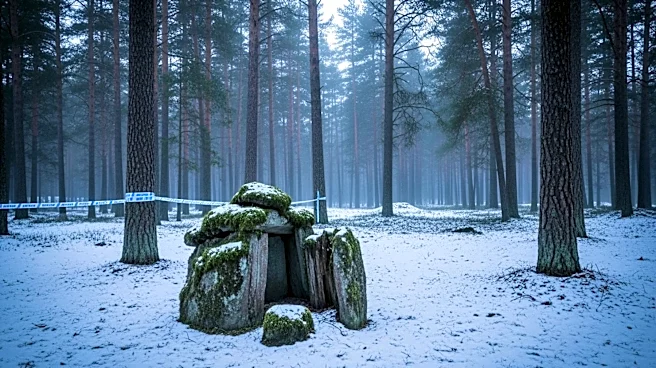
A recent study conducted by the University of Turku has provided new insights into an individual buried near Lake Kitka in Kuusamo, Finland, dating back to the turn of the 17th century. The research, published in BMC Genomics, utilized DNA and isotope
analyses to explore the life history of the individual, who is linked to Sámi cultural heritage. The findings indicate a genetic connection to present-day Sámi populations and suggest that the individual spent part of his life outside Finland. The DNA analysis revealed that the genetic profile of the Kitka individual closely matches that of current and historical Sámi, particularly in North and Northeast Lapland. Isotope analysis further suggests that the individual lived in a region with volcanic bedrock, likely Iceland, during his teenage years. This study challenges previous interpretations of the Kitka individual as a noaidi, a Sámi ritual specialist, suggesting a more complex life history.
Why It's Important?
The study's findings are significant as they provide a deeper understanding of the historical interactions and admixture between Sámi and Finnish populations. This research highlights the complexity of Sámi identity, emphasizing that it is not solely a biological trait but a historical, cultural, and social phenomenon. The insights gained from this study contribute to the broader understanding of Sámi cultural heritage and the historical dynamics of Northern Fennoscandia. Additionally, the research underscores the importance of using advanced scientific methods, such as DNA and isotope analyses, to uncover historical narratives and challenge existing assumptions about cultural identities.