



What's Happening?
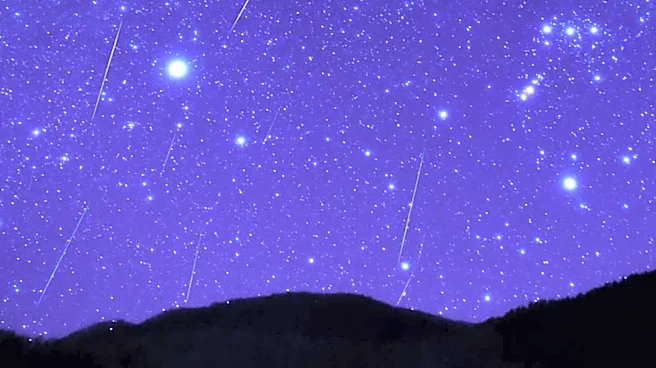
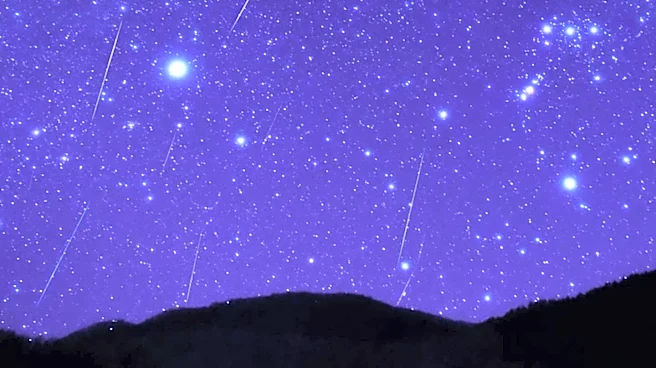
The Leonid meteor shower is set to peak on the night of November 17, marking 60 years since a historic meteor storm in 1966. That year, observers at Kitt Peak in Arizona reported rates as high as 40 meteors per second, totaling approximately 144,000 meteors an
hour during its most intense 15-minute period. This year's event, however, is expected to be significantly quieter, with an anticipated rate of about 15 meteors per hour under ideal dark sky conditions. The Leonids occur annually in November as Earth passes through dust trails left by Comet 55P/Tempel-Tuttle. These tiny particles, typically no larger than a grain of sand, burn up upon entering Earth's atmosphere at high speeds, creating streaks of light. The shower is named after the constellation Leo, from which the meteors appear to radiate.
Why It's Important?
For astronomy enthusiasts and the general public in the U.S., this annual celestial event offers an opportunity for skygazing, even if it's not a 'storm' year. The historical context of the 1966 event highlights the dramatic variability of meteor showers and their potential to captivate public attention, as seen with the 1833 Leonid storm that spurred scientific study of meteors. While this year's display will be modest, it serves as a reminder of the dynamic nature of our solar system and the debris trails left by comets. The event also provides a chance for educational outreach about comets, meteoroids, and atmospheric phenomena, encouraging scientific curiosity among all age groups. The relatively low intensity this year means that casual observers won't need specialized equipment, making it accessible to a broad audience.
What's Next?
The peak viewing for the Leonid meteor shower is expected late on November 17, extending into the early hours of November 18. The Moon will be in its first quarter phase but is projected to set around midnight in most locations, providing darker skies for optimal viewing before dawn. Observers are advised to find a dark location away from city lights, allow their eyes about 20 minutes to adjust to the darkness, and avoid looking at phones to preserve night vision. No telescopes or binoculars are necessary; lying back and observing a wide area of the sky is recommended. Looking further ahead, Comet Tempel-Tuttle's next close approach to the Sun is anticipated in 2031, with some forecasts predicting stronger Leonid activity, potentially hundreds of meteors per hour, around 2033 and 2034, though a storm on the scale of 1966 is not guaranteed.
Beyond the Headlines
The Leonid meteor shower, even in its quieter years, underscores the continuous interaction between Earth and the cosmic environment. The historical accounts of meteor storms, such as those in 1833 and 1966, illustrate how celestial events can profoundly impact human perception and scientific understanding. These events have historically inspired awe, fear, and ultimately, scientific inquiry, leading to a deeper comprehension of our place in the universe. The study of meteor showers also contributes to our understanding of cometary composition and the distribution of dust and debris in the solar system. Furthermore, the act of observing such phenomena fosters a connection to the natural world and encourages a sense of wonder, which can have broader cultural and educational implications, promoting scientific literacy and an appreciation for astronomy.