







What's Happening?
Researchers have discovered a new exoplanet, Beta Pictoris d, in the Beta Pictoris system using spectroscopy imaging. This system, located 63 light-years from Earth, has been extensively studied since its discovery in 1983. The new planet was detected
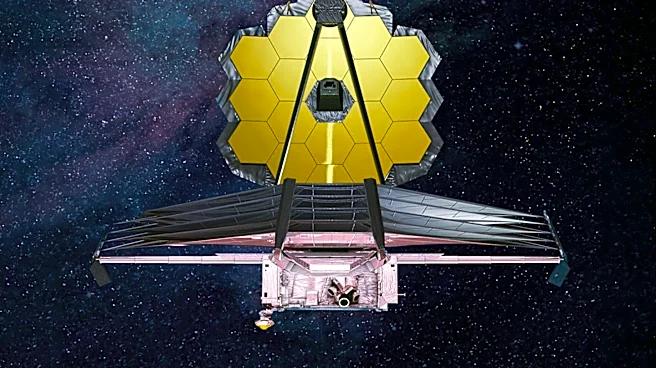
through the James Webb Space Telescope's Near-Infrared Spectrograph, which identified distinct absorption lines indicative of a giant planet's atmosphere. Beta Pictoris d is the smallest of the three known planets in the system but is estimated to be over twice the mass of Jupiter. It orbits its star at a distance similar to Neptune's orbit around the Sun.
Why It's Important?
The discovery of Beta Pictoris d is significant as it adds to the understanding of planetary formation and dynamics in young star systems. The ability to detect and analyze the atmosphere of such distant planets provides valuable insights into their composition and potential habitability. This finding also demonstrates the effectiveness of advanced spectroscopy techniques in penetrating dense cosmic dust to reveal hidden celestial bodies. The Beta Pictoris system, now with three known exoplanets, serves as a crucial model for studying planetary systems' evolution.
What's Next?
Further analysis of data from the James Webb Space Telescope and other observatories will continue to refine the understanding of Beta Pictoris d's characteristics, such as its temperature, orbit, and atmospheric composition. Researchers may also explore the potential for additional undiscovered planets within the system. The findings could influence future exoplanet detection strategies and the development of technologies for studying distant planetary systems.