







What's Happening?
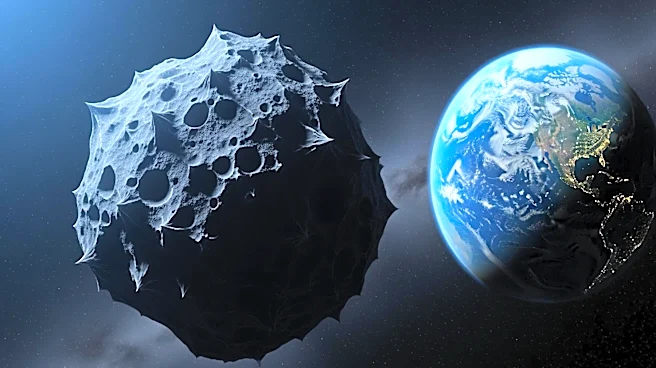
A newly-discovered asteroid, named 2026 JH2, is set to pass unusually close to Earth tonight. Discovered last week by astronomers in Arizona, the asteroid measures approximately 35 meters in diameter, comparable to the length of a five-a-side football
pitch. It will fly by Earth at around 5 PM EDT, coming within 91,000 kilometers of the planet, which is less than a quarter of the distance to the Moon. Despite its proximity, astronomers assure there is no risk of collision with Earth. The event presents a rare opportunity for observation, as the asteroid will not be this close again until 2060. The Virtual Telescope Project plans to live stream the event, allowing those without telescopes to witness the flyby.
Why It's Important?
The close approach of asteroid 2026 JH2 is significant for both scientific and public interest. For astronomers, it provides a rare chance to study an asteroid at close range, enhancing understanding of such celestial bodies. This can contribute to broader knowledge about the composition and behavior of asteroids, which is crucial for planetary defense strategies. For the public, the event offers a unique opportunity to engage with astronomy and space science, potentially inspiring interest in these fields. The live stream by the Virtual Telescope Project makes the event accessible to a global audience, fostering a shared experience of this astronomical phenomenon.
What's Next?
Following its close approach, asteroid 2026 JH2 will continue its orbit, embarking on a 3.8-year journey that takes it near Jupiter before returning towards the Sun. This trajectory is monitored by space agencies to ensure accurate tracking and prediction of future paths. The data collected during this flyby will be analyzed to refine models of asteroid orbits and improve future predictions. Additionally, the event may prompt discussions on the importance of continued investment in space observation technologies and planetary defense initiatives.