
What's Happening?
Recent data reveals that while Thailand's export growth in November fell short of expectations, U.S. exports have experienced a significant surge. According to the Thai Ministry of Commerce, the country's
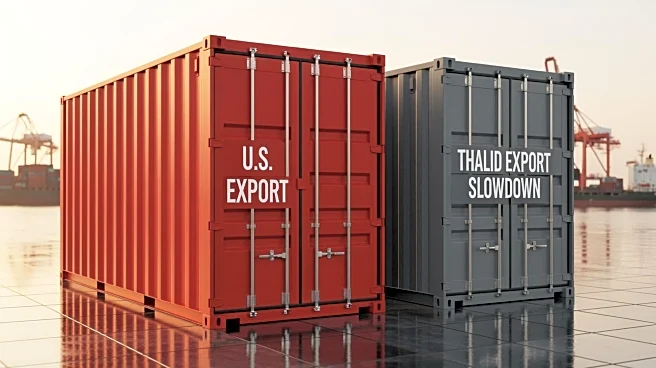
exports rose by 12.6% over the January-November period compared to the previous year. However, the growth rate in November was not as high as anticipated, leading to a wider trade deficit of $2.73 billion, surpassing the forecasted $1.12 billion. The strong performance of the baht, which has appreciated by 10.4% against the dollar, is cited as a factor negatively impacting the export of food and agricultural products. Despite these challenges, exports to the United States, Thailand's largest market, increased by 37.9% year-on-year in November, while exports to China decreased by 7.8%. The U.S. has imposed a 19% tariff on Thai imports, aligning with similar measures on other regional countries.
Why It's Important?
The surge in U.S. exports amidst Thailand's export slowdown highlights the shifting dynamics in global trade, particularly in the context of U.S.-Thailand economic relations. The increase in U.S. exports could bolster the American economy, providing a boost to industries reliant on international markets. Conversely, Thailand's widening trade deficit and the impact of a strong baht on its export sector underscore the challenges faced by emerging markets in maintaining competitive trade balances. The imposition of U.S. tariffs on Thai goods further complicates the trade landscape, potentially affecting bilateral trade negotiations and economic strategies. These developments could influence future trade policies and economic partnerships between the U.S. and Thailand.
What's Next?
Looking ahead, trade negotiations between Thailand and the U.S. are expected to conclude next year, which could lead to adjustments in tariffs and trade agreements. The Thai Ministry of Commerce forecasts a potential rise or fall in exports for 2026, depending on various economic factors, including the performance of the electronics sector. The private sector anticipates significant growth in electronics exports, which could offset some of the challenges faced by other sectors. The outcome of these negotiations and the performance of key industries will be crucial in shaping the future trade relationship between the two countries.




