


What's Happening?
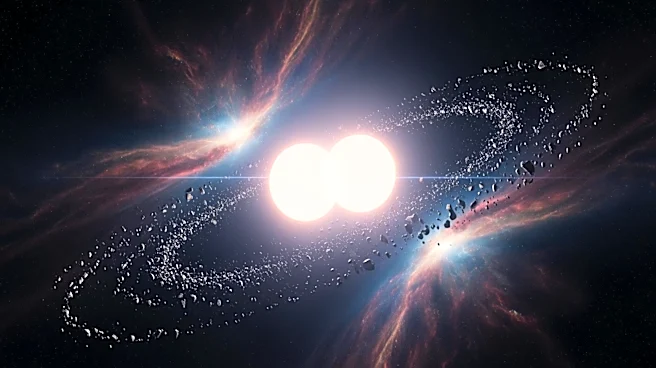
Astronomers have been studying a binary star system, HD 81809, where two stars that likely formed together exhibit significantly different chemical compositions. This anomaly has led researchers to hypothesize that one of the stars may have engulfed its
own planets. The primary star, HD 81809A, is a subgiant, while the secondary star, HD 81809B, remains a main-sequence star with notable lithium enrichment and a higher iron content. The chemical disparity between the stars is too large to be explained by standard stellar evolution theories. A recent study led by Nuno Moedas from the Technical University of Denmark used computer simulations to explore the possibility of planet engulfment as a cause for the observed chemical properties. The simulations suggest that the secondary star may have accreted 25-75 Earth masses of metals, potentially explaining its high metallicity.
Why It's Important?
This study is significant as it challenges existing theories of stellar evolution and chemical composition in binary systems. Understanding such anomalies can provide insights into the processes of planet formation and destruction, as well as the dynamic interactions within star systems. The findings could have broader implications for the study of exoplanets and the potential for life in other solar systems. If planet engulfment is confirmed, it would highlight the complex and sometimes violent nature of stellar environments, influencing how astronomers search for and study exoplanets. This research also underscores the importance of precise chemical analysis in unraveling the history and evolution of stars.
What's Next?
Future research will likely focus on gathering more observational data to confirm the planet engulfment hypothesis. Detecting rotation and magnetic activity on HD 81809B could provide additional evidence of such an event. Further studies may also explore the chemical composition of the accreted material to resolve discrepancies, such as the unexpected lithium levels. Continued advancements in simulation techniques and observational technologies will be crucial in verifying these findings and expanding our understanding of stellar and planetary interactions.