
What's Happening?
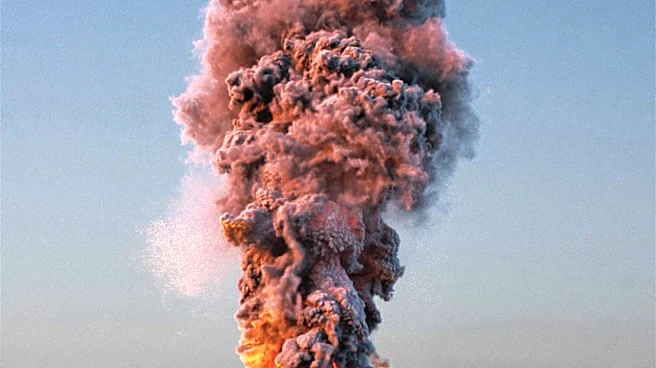
Mount Kanlaon volcano in the central Philippines, specifically on Negros Island, experienced a moderately explosive eruption yesterday at 12:46 PM local time. The eruption, which lasted approximately two
minutes, generated a significant ash plume that rose between 5 to 6 kilometers above the volcano's crater. The Philippine Institute of Volcanology and Seismology reported this event and indicated that the ashfall is expected to drift towards the north and northeast. Following the eruption, Alert Level 2 remains in effect for Mount Kanlaon, with Level 5 being the highest on the scale. The Philippines is situated within the Pacific 'Ring of Fire,' a region known for its high susceptibility to both earthquakes and volcanic eruptions.
Why It's Important?
While this event occurred outside the U.S., it highlights the broader geological activity within the Pacific 'Ring of Fire,' a zone that also impacts U.S. territories and states, particularly those along the Pacific coast like California, Oregon, Washington, and Alaska, as well as Hawaii. Volcanic eruptions and seismic events in this region can have far-reaching effects, including disruptions to air travel due to ash clouds, which can impact global supply chains and tourism, affecting U.S. businesses and travelers. Furthermore, understanding the dynamics of such eruptions contributes to global scientific knowledge, which is crucial for improving early warning systems and disaster preparedness in all seismically active regions, including those within the U.S. The event serves as a reminder of the interconnectedness of global geological processes and their potential indirect impacts on U.S. interests.
What's Next?
Authorities will continue to monitor Mount Kanlaon for further activity, maintaining Alert Level 2. The Philippine Institute of Volcanology and Seismology will likely issue updates regarding ashfall distribution and any changes in the volcano's status. Residents in affected areas will need to take precautions against ashfall, which can cause respiratory issues and damage infrastructure. For the U.S., there are no immediate direct consequences, but the event reinforces the need for ongoing monitoring of the Pacific 'Ring of Fire' for potential impacts on air travel routes and the safety of U.S. citizens traveling in the region. International cooperation in volcanology and disaster response will remain crucial.
Beyond the Headlines
The eruption of Mount Kanlaon underscores the constant geological forces at play in the Pacific 'Ring of Fire,' a region where approximately 90% of the world's earthquakes and 75% of the world's active volcanoes occur. This event, while localized to the Philippines, serves as a global reminder of the inherent risks associated with living in geologically active zones. It highlights the critical role of scientific institutions in monitoring these natural phenomena and providing timely warnings. The long-term implications include the continuous need for robust disaster preparedness and mitigation strategies, not only in directly affected countries but also for nations like the U.S. that have interests and populations within or near this volatile region. It also prompts discussions on climate change's potential influence on geological stability, though direct links are still under scientific investigation.