
What's Happening?
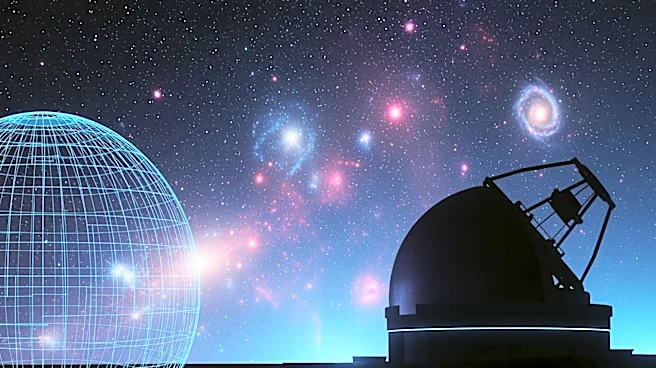
The Dark Energy Spectroscopic Instrument (DESI) has successfully completed its ambitious five-year celestial survey, resulting in the largest high-resolution 3D map of the universe. This project, conducted
from the Kitt Peak National Observatory in Arizona, captured data from over 47 million galaxies and quasars, surpassing its initial goal of 34 million. The survey, which began in May 2021, concluded on April 15, 2026, and has provided a comprehensive view of 11 billion years of cosmic history. DESI's observations have already suggested that dark energy, previously thought to be constant, may be weakening, which could significantly alter current cosmological theories. The project involved over 900 researchers from more than 70 institutions worldwide, highlighting its collaborative nature.
Why It's Important?
The completion of DESI's survey marks a significant milestone in astrophysics, offering unprecedented data that could reshape our understanding of the universe. The potential discovery that dark energy is weakening challenges the existing notion that it is a constant force driving the universe's accelerated expansion. This could lead to new theories about the universe's evolution and its ultimate fate. The data will allow scientists to compare the distribution of galaxies over billions of years, providing insights into how the universe has evolved since its inception. This project not only advances scientific knowledge but also demonstrates the power of international collaboration in tackling complex scientific questions.
What's Next?
With the survey completed, researchers will now focus on analyzing the vast amount of data collected. This analysis will aim to uncover subtle features of dark energy and further understand its role in the universe's expansion. DESI will continue to map challenging regions of the sky, such as those near the Milky Way's plane, until 2028. The ongoing expansion of the map will add to the already extensive dataset, providing even more opportunities for discovery. As analysis techniques improve and complementary datasets grow, the scientific community anticipates new revelations about the cosmos.
Beyond the Headlines
The DESI project highlights the challenges and opportunities presented by big data in modern science. With an overwhelming amount of information now available, researchers face the task of developing new methods to process and interpret these data effectively. This situation contrasts sharply with past decades when data scarcity was a significant limitation. The project's success also underscores the importance of sustained funding and international cooperation in advancing scientific frontiers.