



What's Happening?
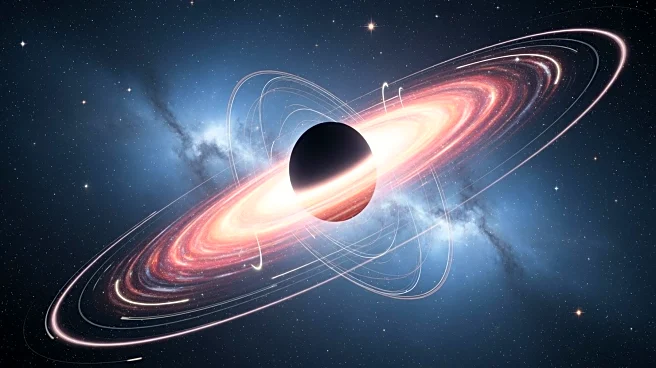
Astronomers have observed a supermassive black hole exhibiting a rare phenomenon known as Lense-Thirring precession, or frame-dragging, as it devours a star. This event, involving a black hole twisting space-time, was detected through a tidal disruption
event (TDE) named AT2020afhd. The study utilized X-ray data from NASA's Neil Gehrels Swift Observatory and radio waves from the Karl G. Jansky Very Large Array. The black hole's gravitational pull caused the star to collapse into an accretion disk, with some material being absorbed and the rest ejected as powerful jets. These observations provide strong evidence of frame-dragging, a concept rooted in Einstein's theory of general relativity, which suggests that massive rotating objects can drag space-time along with them.
Why It's Important?
This discovery is significant as it provides the most convincing evidence yet of frame-dragging, a key prediction of general relativity. Understanding this effect is crucial for comprehending how black holes interact with their surroundings, including the formation of accretion disks and jets. The findings open new avenues for studying black hole dynamics and the extreme environments around them. This research not only confirms theoretical predictions but also enhances our understanding of cosmic phenomena, potentially influencing future astronomical studies and technologies related to space-time manipulation.
What's Next?
Further research is expected to delve deeper into the physical processes behind frame-dragging and its implications for black hole behavior. Scientists may conduct additional observations of similar tidal disruption events to refine models of black hole dynamics. These studies could lead to advancements in our understanding of the universe's most mysterious objects and their role in cosmic evolution. The ongoing exploration of these phenomena will likely continue to challenge and expand the boundaries of astrophysics.