

What's Happening?
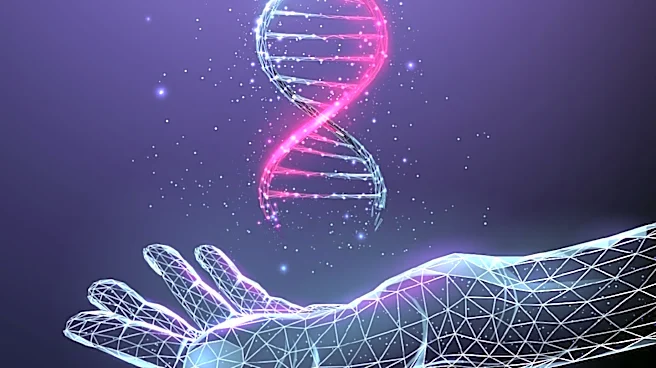
Researchers at UC Berkeley have developed a new computational technique to identify regions of DNA in modern humans inherited from two unknown ancestors. This study, published in Science, reveals that modern humans interbred with at least four archaic
human relatives, including Neanderthals and Denisovans. The technique, called TRACE, uses modern human genomes to map ancient genealogical relationships, identifying 'ghost' and 'super-archaic' ancestors. The ghost ancestor interbred with humans in Africa over 50,000 years ago, while the super-archaic ancestor, a 1.8 million-year-old lineage, interbred with Denisovans in Eurasia.
Why It's Important?
This discovery provides a deeper understanding of human evolutionary history, highlighting the complex web of interbreeding among ancient human populations. The findings suggest that genetic contributions from these unknown ancestors have been pervasive, influencing modern human genomes. This research could reshape our understanding of human ancestry and evolution, offering insights into how ancient genetic variations have impacted modern human biology and adaptation.
What's Next?
The researchers plan to further explore the genetic contributions of these ancient lineages and their impact on modern human health and disease. As genome databases become more diverse, additional lineages may be identified, enhancing our understanding of human evolution. The discovery of more Denisovan genomes and protein sequences from Homo erectus fossils could provide further clarity on these ancient interactions.