



What's Happening?
Egypt's Foreign Minister Badr Abdelatty met with Libya’s acting Minister of Oil and Gas, Khalifa Abdulsadek, in Tripoli on November 7 to push for accelerated progress on joint energy projects. The discussions focused on the Egypt-Libya gas pipeline, which
aims to connect the two countries' networks, and initiatives for refining Libyan crude oil at Egyptian facilities for re-export. The meeting also addressed the rehabilitation of Libya’s refineries and an electricity interconnection project. This diplomatic engagement follows the official reopening of the Egyptian embassy in Tripoli by Foreign Minister Abdelatty, ending a 12-year closure and signaling a warming of relations between Cairo and Libya’s western administration. Libya's acting Minister of Oil and Gas, Khalifa Abdulsadek, has indicated he will continue technical talks in Cairo with Egypt's petroleum and electricity ministers.
Why It's Important?
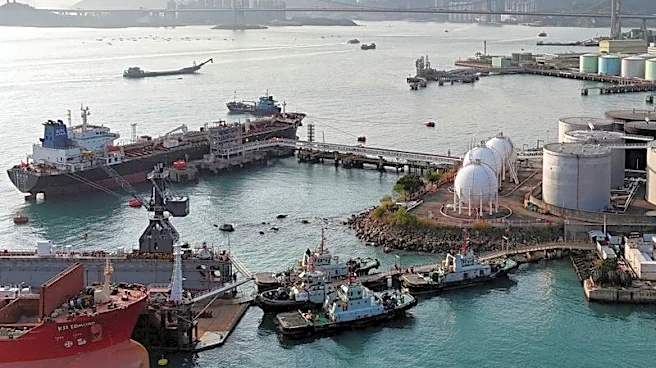
This push for energy cooperation is significant for both Egypt and Libya, particularly in the context of regional energy security and economic stability. Egypt's gas production has been declining, falling from 6.56 billion cubic feet per day in 2021 to 3.94 bcf/d in 2025, while consumption remains high at around 6 bcf/d. This has led to Egypt importing a record 9.01 million tonnes of LNG last year, with the cost of a standard LNG cargo increasing significantly. By refining Libyan crude and establishing gas pipeline links, Egypt aims to secure its energy supply and potentially reduce its reliance on costly LNG imports. For Libya, utilizing Egypt's refining capacity, which can process 40 million tonnes of crude annually, offers a solution to its own refining limitations, as its current output is capped at 180,000 barrels per day against a nominal capacity of 380,000. This collaboration could also foster greater economic integration and stability in the region, mitigating the impact of broader Middle East conflicts.
What's Next?
The next step involves technical talks in Cairo, where Libya’s acting Minister of Oil and Gas, Khalifa Abdulsadek, will meet with Egypt’s petroleum and electricity ministers to further discuss the details of the proposed energy projects. These discussions are expected to focus on the practical implementation of the gas pipeline and crude refining initiatives, as well as the rehabilitation of Libyan refineries and the electricity interconnection. The warming diplomatic relations, marked by the reopening of the Egyptian embassy in Tripoli, suggest a conducive environment for these projects to move forward. The outcome of these technical meetings will determine the timeline and scope of the energy cooperation, potentially leading to concrete agreements and investments in the near future.
Beyond the Headlines
The renewed focus on energy cooperation between Egypt and Libya extends beyond immediate economic benefits, signaling a broader geopolitical shift in the region. The thawing of diplomatic tensions and the emphasis on shared energy interests could contribute to greater regional stability and cooperation, potentially reducing the influence of external actors. This collaboration could also set a precedent for other North African nations to pursue similar cross-border energy initiatives, fostering a more integrated and resilient regional energy market. Furthermore, the rehabilitation of Libya's energy infrastructure, supported by Egyptian expertise, could play a crucial role in Libya's post-conflict recovery and economic development, providing long-term stability and prosperity for its citizens.