






What's Happening?
Congressman Ted W. Lieu (D-Los Angeles County) and Senator Ed Markey (D-MA) have formally urged President Trump to engage General Secretary Xi Jinping on the principle of maintaining a 'human-in-the-loop' for nuclear launch decisions involving Artificial
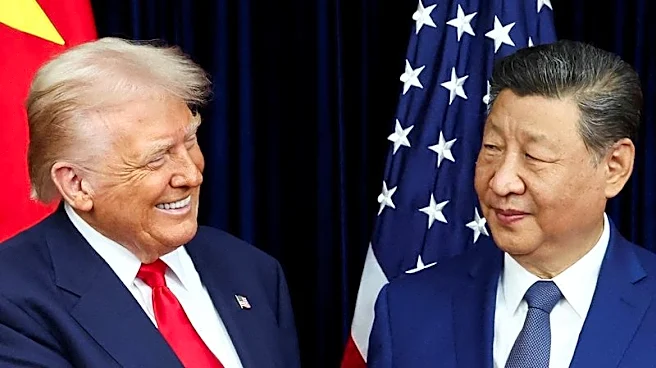
Intelligence (AI). This appeal comes as President Trump prepares for an upcoming meeting with General Secretary Xi. The United States has already established this policy, ensuring human decision-makers in the employment of nuclear weapons, through a provision co-authored by Rep. Lieu and Sen. Markey in the Fiscal Year 2025 National Defense Authorization Act (NDAA). Section 1638 of this act explicitly states that U.S. policy dictates AI should not compromise nuclear safeguards and that a human must always be involved in nuclear launch decisions, preventing AI from autonomously launching nuclear weapons. The lawmakers are advocating for China to adopt a similar commitment to prevent potential AI-driven nuclear disasters.
Why It's Important?
This initiative is crucial for global stability and nuclear security, particularly in an era of rapidly advancing AI technology. The U.S. policy, enshrined in the 2025 NDAA, sets a precedent for responsible AI integration in critical defense systems by mandating human oversight in nuclear launch protocols. By urging President Trump to secure a similar commitment from China, Lieu and Markey aim to establish an international norm that prevents the autonomous deployment of nuclear weapons by AI. This could mitigate the risk of accidental or escalatory nuclear conflicts stemming from AI malfunctions or misinterpretations. The absence of such a commitment from a major nuclear power like China could lead to a dangerous arms race in AI-driven weaponry, increasing the likelihood of catastrophic errors. Ensuring human control over nuclear arsenals is paramount to preventing unintended global devastation and fostering a more secure international environment.
What's Next?
The immediate next step involves President Trump's upcoming meeting with General Secretary Xi Jinping, where he is urged to raise this critical issue. The success of this diplomatic effort will depend on China's willingness to adopt a similar 'human-in-the-loop' principle for its nuclear launch decisions. Should China agree, it would mark a significant step towards international consensus on AI ethics in military applications. Conversely, a lack of commitment from China could prompt further legislative or diplomatic actions from the U.S. and its allies to address the potential risks of AI in nuclear warfare. Domestically, the bipartisan support for this principle in the U.S. Congress suggests continued legislative efforts to reinforce human control over advanced military AI systems, potentially influencing future defense policies and international arms control discussions.
Beyond the Headlines
The push for human control over AI in nuclear launch decisions extends beyond immediate security concerns, touching upon profound ethical and philosophical questions about the role of autonomous systems in warfare. It highlights the growing tension between technological advancement and the imperative for human accountability in decisions of existential consequence. This debate could shape the future of international law regarding autonomous weapons and the development of global norms for AI governance. The potential for AI to accelerate decision-making beyond human comprehension or to introduce unforeseen biases into critical systems underscores the need for robust ethical frameworks. This effort by Lieu and Markey could serve as a foundational step in establishing a global standard that prioritizes human judgment and control in the most sensitive areas of national security, influencing how nations approach AI development and deployment in other high-stakes domains.