






What's Happening?
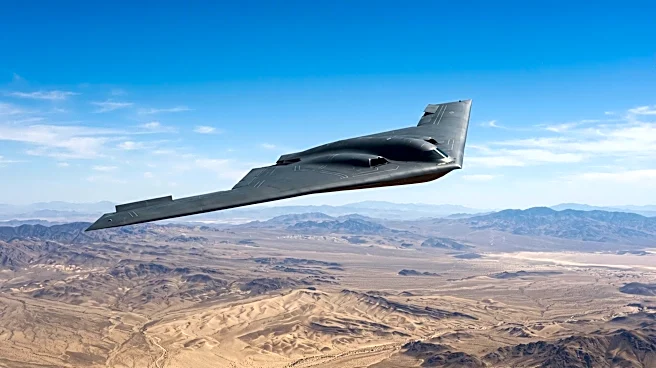
The B-21 Raider stealth bomber has successfully completed its first weapon release test, marking a significant milestone in its development. The test involved a B-21 aircraft flying from Edwards Air Force Base, California, releasing a conventional weapon.
This event validates the bomber's digital models and the maturity of its open systems architecture, confirming its strike capability and ability to rapidly integrate new weapons. The U.S. Air Force and Northrop Grumman announced this development, emphasizing the B-21's role as the future backbone of the U.S. bomber fleet. The specific munition released was not identified, but the B-21 is designed to carry a wide array of conventional and nuclear armaments, including the AGM-181A Long Range Stand-Off (LRSO) nuclear-armed cruise missile.
Why It's Important?
This successful weapon release test is crucial for the B-21 program, as it demonstrates the bomber's operational readiness and validates its design principles. The B-21 is intended to provide the U.S. Air Force with advanced, penetrating strike capabilities for decades to come, capable of operating in heavily defended airspace. Its ability to rapidly onboard new weapons ensures adaptability against evolving threats, enhancing national security. The program's progress, particularly its adherence to schedule and budget, is seen as a model acquisition effort. This development reinforces the U.S.'s strategic deterrence posture and its capacity to project power globally, assuring allies and deterring potential adversaries.
What's Next?
The B-21 program is on an aggressive timeline, with the Air Force aiming for initial operational capability (IOC) in 2027. With two flying pre-production Raiders and a planned test force of six aircraft, testing will continue to expand in scope, focusing on validating key operational capabilities, including in-flight refueling. The Air Force plans to acquire at least 100 B-21s, with a new target fleet size expected next year, and has already announced plans to accelerate production. The first operational B-21s are scheduled to arrive at Ellsworth Air Force Base in South Dakota next year. Future tests will likely explore the bomber's multi-mission capabilities, potentially extending into air-to-air combat, further solidifying its role as a versatile sixth-generation system.
Beyond the Headlines
The B-21 Raider's successful weapon release signifies more than just a technical achievement; it represents a strategic shift in U.S. air power. Its advanced stealth capabilities and open systems architecture are designed to counter sophisticated air defense systems, ensuring the U.S. maintains air superiority in future conflicts. The emphasis on digital engineering and rapid weapon integration reflects a broader trend in defense acquisition towards more agile and adaptable platforms. This bomber is not just a replacement for older aircraft but a foundational element of future joint force operations, potentially influencing military doctrine and strategic planning for decades. Its development also highlights the ongoing technological competition among global powers, pushing the boundaries of aerospace engineering and defense capabilities.