

What's Happening?
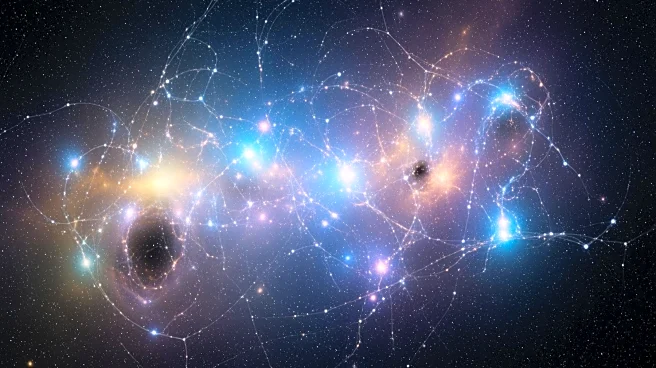
Astronomers have developed a groundbreaking 3D map of the early universe, unveiling a vast 'sea of light' from hydrogen that was previously undetectable. This map, created using data from the Hobby-Eberly Telescope Dark Energy Experiment (HETDEX), captures
light emitted by excited hydrogen atoms 9 to 11 billion years ago during the universe's peak star-forming era. The study employs a technique called Line Intensity Mapping, which measures the combined light from hydrogen's Lyman-alpha wavelength across large sky areas. This approach allows scientists to trace not only bright galaxies but also the diffuse gas that connects them, offering a comprehensive view of the universe's structure during its formative years.
Why It's Important?
This development marks a significant advancement in cosmic cartography, providing a more detailed understanding of how galaxies formed and evolved. By mapping the faint glow of hydrogen gas and small galaxies, astronomers can better comprehend the large-scale structures of the universe. This research could lead to new insights into the role of intergalactic gas in galaxy formation and evolution. The study also highlights a shift towards using intensity mapping in future surveys, which may reveal the full framework of the universe, not just its brightest objects. This could have profound implications for our understanding of cosmic history and the forces shaping the universe.