


What's Happening?
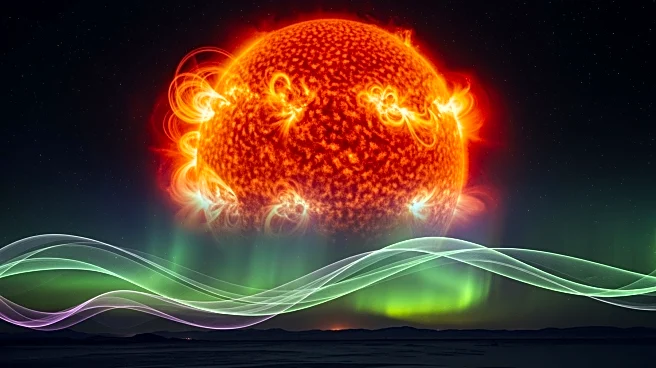
A highly active sunspot, identified as region 4366, has emerged on the sun's surface, rapidly growing to a significant size and becoming the most active sunspot of the current solar cycle. This sunspot has been responsible for firing off dozens of powerful
solar flares, including the strongest solar eruption in years. The National Oceanic and Atmospheric Administration's Space Weather Prediction Center (SWPC) has issued an alert predicting that a coronal mass ejection (CME) from this sunspot is likely to pass close to Earth, potentially causing a minor geomagnetic storm. This could result in vibrant auroras visible at lower latitudes than usual. The sunspot's activity peaked with an X8.1 solar flare, the strongest since October 2024, which caused partial radio blackouts in the South Pacific.
Why It's Important?
The activity of sunspot region 4366 is significant due to its potential impact on Earth's geomagnetic environment. Solar flares and CMEs can disrupt radio communications, GPS systems, and even damage satellites and spacecraft. The predicted geomagnetic storm could lead to widespread auroral displays, providing a rare opportunity for people in lower latitudes to witness the northern lights. Additionally, the increased solar activity highlights the ongoing solar maximum, a period of heightened solar activity that occurs every 11 years. Understanding and predicting these solar events are crucial for mitigating their effects on technology and infrastructure.
What's Next?
As the sunspot continues to face Earth, further monitoring by NOAA and other space weather agencies will be essential to predict and manage potential impacts. If the CME does impact Earth, it could lead to more intense auroras and possible disruptions in communication systems. Stakeholders in the telecommunications and satellite industries will need to prepare for potential disturbances. Continued research and observation will help improve predictive models for solar activity, aiding in the development of strategies to protect technological systems from solar-induced disruptions.