








What's Happening?
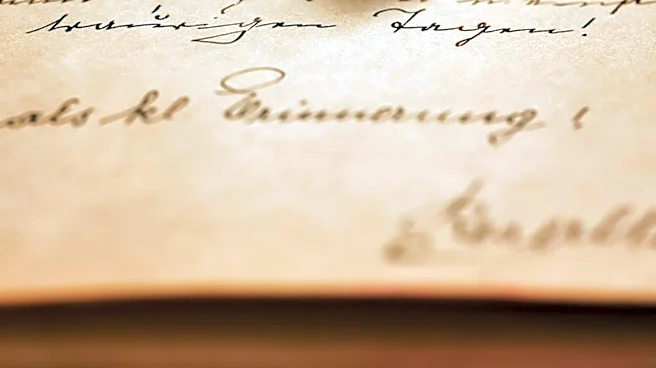
Elie Wiesel, a prominent Holocaust survivor and author, maintained a rich network of friendships and literary connections throughout his life. His correspondence with fellow Holocaust survivor and writer Primo Levi highlights a deep bond formed over shared
experiences in Auschwitz. Wiesel's archive also contains a surprising find: the original manuscript of Allen Ginsberg's poem 'Kaddish,' entrusted to him by Ginsberg himself. These relationships reflect Wiesel's role as a central figure in post-war Jewish intellectual circles, engaging with notable figures such as Jean Améry and Albert Camus. Wiesel's friendships were characterized by mutual respect and a shared commitment to bearing witness to the Holocaust's horrors.
Why It's Important?
Wiesel's extensive network underscores his influence in shaping Holocaust literature and memory. His friendships with other survivors and intellectuals provided a platform for dialogue and reflection on the moral and philosophical implications of the Holocaust. The discovery of Ginsberg's manuscript in Wiesel's archive highlights the trust and esteem he commanded among his contemporaries. Wiesel's interactions with figures like Camus and Mauriac also illustrate the cross-cultural exchanges that enriched his work and contributed to a broader understanding of Jewish identity and history. These connections emphasize the importance of preserving and studying such archives to gain insights into the intellectual and cultural history of the 20th century.