

What's Happening?
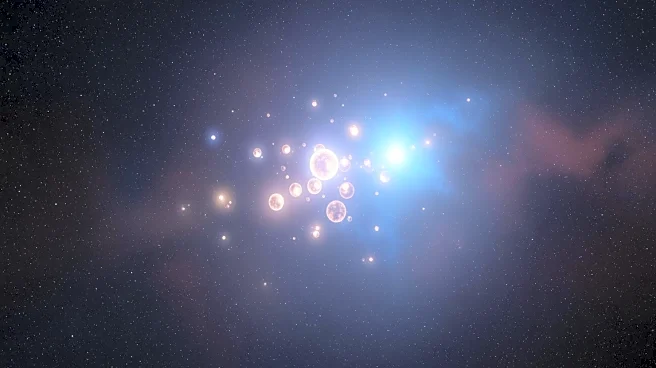
The James Webb Space Telescope has captured a new image of the Westerlund 2 star cluster, located 20,000 light-years from Earth in the constellation Carina. This cluster, a star-forming nebula known as Gum 29, is home to approximately 3,000 stars, including
some of the hottest and most massive stars in the Milky Way galaxy. The image, which combines data from the telescope's Near-Infrared Camera and Mid-Infrared Instrument, highlights the young, massive stars and the surrounding clouds and walls of dust shaped by their intense light. The observations also identified a population of brown dwarfs, or 'failed stars,' which are objects with masses between those of typical stars and planets but lack the mass to trigger nuclear fusion in their cores.
Why It's Important?
The discovery of brown dwarfs in the Westerlund 2 cluster provides valuable insights into the different stages of star formation and the dynamics of planet-forming disks around massive stars. Brown dwarfs, which straddle the line between stars and planets, offer a unique opportunity to study the processes that govern star and planet formation. The James Webb Telescope's ability to capture detailed images across a wide range of infrared wavelengths allows astronomers to explore these phenomena in greater depth, enhancing our understanding of the universe's complex star-forming regions.
What's Next?
Future observations by the James Webb Space Telescope are expected to continue shedding light on the processes of star and planet formation. By studying the Westerlund 2 cluster and similar regions, astronomers aim to unravel the mysteries of how stars and planets evolve over time. These findings could have significant implications for our understanding of the formation of solar systems, including our own, and the potential for life elsewhere in the universe.
Beyond the Headlines
The identification of brown dwarfs in the Westerlund 2 cluster also raises questions about the classification of celestial objects and the criteria used to distinguish between stars and planets. As our observational capabilities improve, the line between these categories may become increasingly blurred, prompting a reevaluation of how we define and categorize objects in space. This could lead to new insights into the diversity and complexity of the universe.