





What's Happening?
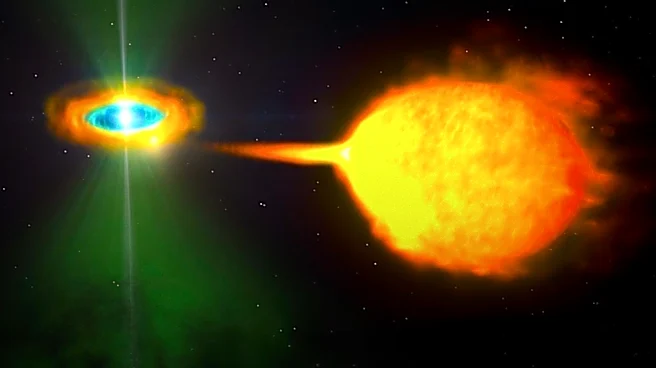
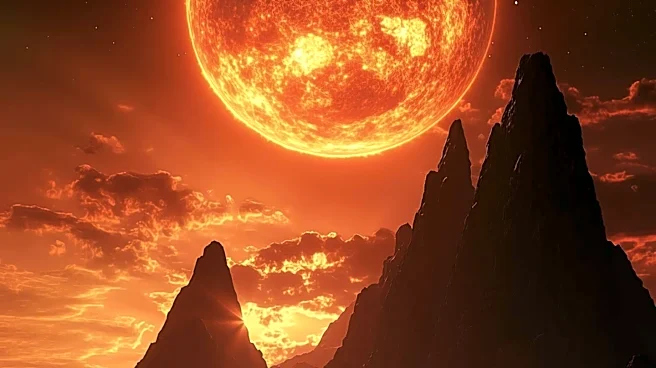
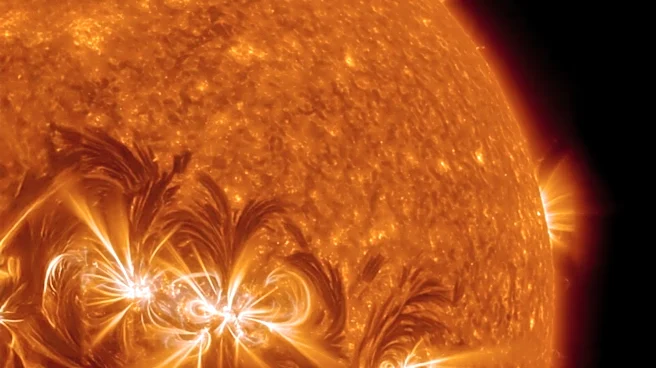
A new study published in Astronomy and Astrophysics suggests that Earth might escape being engulfed by the Sun when it expands into a red giant in about five billion years. The study examines two potential scenarios: Earth could either be pulled into the Sun and destroyed
or drift into a wider orbit and survive. This outcome depends on the Sun's gravitational tidal interactions and its mass-loss rates during the Asymptotic Giant Branch (AGB) phase. Researchers used observations of a nearby dying star, L2 Pup, which mimics the future Sun, to measure mass loss and recalculate Earth's chances of survival. Despite the possibility of Earth surviving, the study indicates that humanity's fate remains sealed due to the inhospitable conditions that would arise.
Why It's Important?
The study challenges long-held beliefs about the inevitable destruction of Earth during the Sun's red giant phase, offering a new perspective on planetary survival. This research could influence future studies on stellar evolution and planetary dynamics, providing insights into the long-term fate of planets in similar systems. Understanding the factors that could allow Earth to survive may also inform the search for habitable exoplanets around aging stars. However, the study also highlights the limitations of human survival, as the conditions on Earth would become uninhabitable long before the Sun reaches its final stages.
Beyond the Headlines
The study raises ethical and philosophical questions about humanity's long-term survival and the importance of space exploration. As scientists continue to explore the universe, understanding the potential for planetary survival could influence future space missions and the search for new habitable worlds. Additionally, the research underscores the need for continued investment in astronomical studies to better understand the complex dynamics of stellar and planetary evolution.