
What's Happening?
A team of astronomers from the University of California, Irvine, and the Caltech Infrared Processing and Analysis Center has discovered the largest and most extended jet ever observed in a nearby galaxy,
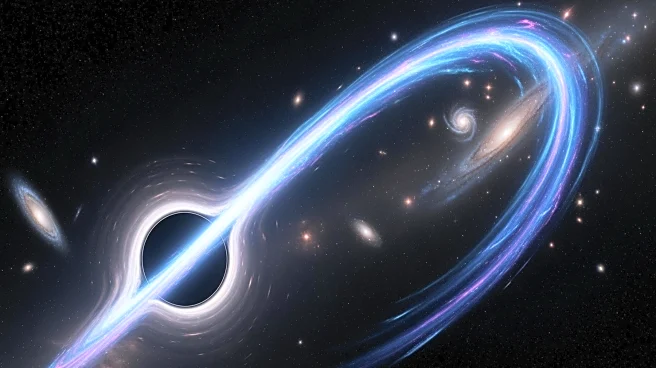
VV340a. This jet, extending up to 20,000 light-years from the galaxy's center, was identified using the W. M. Keck Observatory on Maunakea, Hawaii. The discovery also revealed vast 'wobbly' structures, providing the clearest evidence to date that supermassive black holes (SMBHs) can significantly reshape their host galaxies beyond their cores. The findings, published in the journal Science, were presented at the 247th Meeting of the American Astronomical Society. The Keck Cosmic Web Imager (KCWI) allowed the team to model the material being expelled and assess its impact on the galaxy's evolution. The study combined data from the Keck Observatory, the James Webb Space Telescope, and the Karl G. Jansky Very Large Array, revealing a pair of plasma jets twisted into a helical pattern.
Why It's Important?
This discovery challenges existing theories about the co-evolution of galaxies and their supermassive black holes. Typically, such jets are observed in older elliptical galaxies, but this finding in a relatively young galaxy like VV340a suggests that these phenomena can occur earlier in a galaxy's life cycle. The presence of a precessing, kiloparsec-scale radio jet in a disk galaxy like VV340a, which is still in the early stages of a galactic merger, could provide new insights into the formation and evolution of galaxies, including the Milky Way. The study highlights the dynamic nature of galaxies and the potential for SMBHs to influence star formation and galactic structure significantly.
What's Next?
The research team plans to conduct higher-resolution radio observations to determine if a second SMBH could be causing the observed jet wobble in VV340a. This could further illuminate the mechanisms behind such phenomena and their prevalence in the universe. The ongoing collaboration between powerful observatories like Keck, JWST, and VLA is expected to continue opening new windows into understanding how galaxies change over time, potentially leading to more groundbreaking discoveries in the field of astrophysics.