
What's Happening?
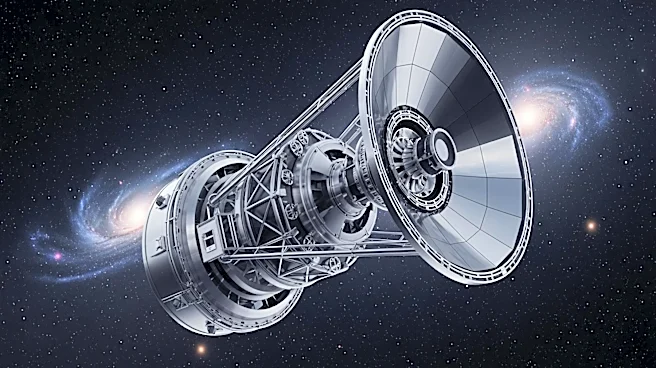
AI technology has significantly accelerated the analysis of data from NASA's James Webb Space Telescope, reducing the time required from years to mere days. This advancement has led to numerous groundbreaking
discoveries that might have otherwise been missed. The same AI technology is now being applied to the Vera C. Rubin Observatory in Chile to enhance the quality of its images. The observatory, which began operations in 2025, aims to create a 10-year timelapse of celestial movements. However, its observations are often distorted due to atmospheric interference. Researchers from the University of California, Santa Cruz, have developed an AI algorithm to remove these distortions, improving image resolution to a level comparable to space-based telescopes.
Why It's Important?
The use of AI in astronomical data analysis represents a significant leap forward in maximizing the scientific return on investments in astronomical observatories. The Vera C. Rubin Observatory, with its $800 million cost, benefits from this technology by producing clearer images, thus enhancing the quality of data available for scientific research. This development not only accelerates the pace of discovery but also allows for more detailed observations of celestial phenomena, potentially leading to new insights into the universe. The integration of AI in this field underscores the growing importance of technology in scientific research, offering tools that can handle vast amounts of data more efficiently than traditional methods.