
What's Happening?
NASA's Science Mission Directorate (SMD) is preparing to introduce a new program element under the Planetary Science Division (PSD) as part of the ROSES-2025 solicitation. The program, named Science Transport
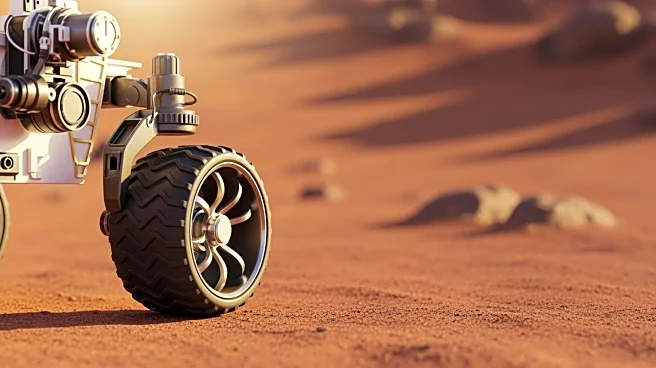
& Robotic Innovation for Deployment and Exploration (STRIDE), aims to solicit proposals from U.S. industry for the design of advanced robotic systems capable of surface and aerial mobility on Mars. These systems are intended to transport and deploy payloads across the Martian surface. The initiative will use a direct proposal submission process and is open to for-profit U.S. organizations. NASA anticipates awarding multiple contracts, contingent on the availability of funds and the merit of the proposals. The program seeks to identify commercial systems that can operate in the Martian environment, addressing key capability gaps and enhancing the landscape of robotic exploration on Mars.
Why It's Important?
The STRIDE program represents a significant step in advancing Mars exploration technology by leveraging commercial innovation. By inviting proposals from a broad range of providers, including terrestrial robotics companies, NASA aims to foster the development of scalable and adaptable mobility solutions for Mars missions. This initiative could lead to more cost-effective and efficient methods of transporting scientific payloads on Mars, potentially accelerating the pace of discovery and exploration. The program's focus on identifying capability gaps and enhancing science return underscores its importance in maintaining U.S. leadership in space exploration and technology development.
What's Next?
As the ROSES-2025 solicitation progresses, interested parties will prepare to submit proposals once the official program element is released. NASA will evaluate these proposals based on their potential to meet the program's objectives and their ability to operate in realistic Martian environments. The outcome of this solicitation could influence future Mars missions, with selected technologies potentially being integrated into upcoming exploration efforts. Stakeholders in the space industry will be closely monitoring the program's developments, as successful proposals could lead to new partnerships and opportunities in the field of space exploration.