
What's Happening?
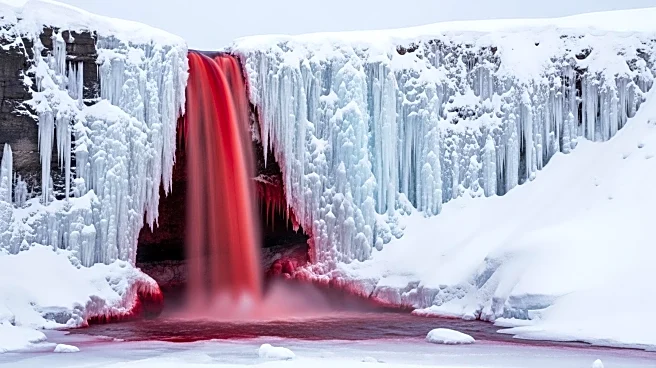
Researchers have identified the cause behind the mysterious Blood Falls in Antarctica, a phenomenon where red-stained water flows from the Taylor Glacier. This occurrence was first noted in 1911 by geologist Thomas Griffith Taylor. The red color is due
to iron-rich brine that is expelled from beneath the glacier. The study, led by Peter T. Doran from Louisiana State University, found that the brine discharge is linked to changes in subglacial water pressure. The glacier's surface dropped by 0.6 inches, and its forward motion slowed by 10 percent during the discharge. This event is characterized by episodic pulses of brine, which reduce subglacial water pressure and affect the glacier's movement.
Why It's Important?
Understanding the Blood Falls phenomenon provides insights into subglacial hydrology and the dynamics of Antarctic glaciers. This research highlights the impact of subglacial water pressure on glacier movement, which is crucial for predicting future changes in glacier behavior due to environmental shifts. The findings could have broader implications for understanding ice dynamics in other polar regions, potentially affecting global sea level rise predictions. The study emphasizes the need for continued monitoring to detect changes driven by long-term environmental factors.
What's Next?
The researchers suggest that ongoing and expanded monitoring of glacial and limnological conditions is necessary to track changes in the frequency and magnitude of brine discharge events. This data will help scientists better understand the long-term impacts of environmental changes on Antarctic glaciers. Future studies may focus on the implications of these findings for other glacial systems and their contribution to global sea level changes.
Beyond the Headlines
The study of Blood Falls not only solves a century-old mystery but also sheds light on the complex interactions between ice, water, and climate. It underscores the importance of interdisciplinary research in uncovering the hidden processes beneath glaciers. The findings may also inspire further exploration of subglacial ecosystems and their unique adaptations to extreme environments.