
What's Happening?
A recent study has examined the effects of sand-gravel replacement on the frost heave characteristics of trapezoidal concrete-lined canals in cold regions. The research focused on the hydrothermal coupling
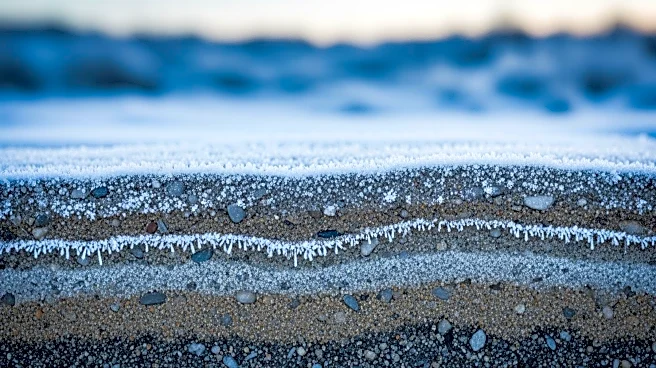
and frost heave behavior of these canals, particularly how varying thicknesses of sand-gravel replacement influence soil moisture and temperature during freeze-thaw cycles. The study found that sand-gravel replacement significantly affects the distribution of soil temperature and moisture, which in turn impacts frost heave displacement and stress on canal linings. The research revealed that increasing the thickness of the sand-gravel layer reduces frost heave displacement and stress, promoting more uniform deformation and enhancing frost resistance. The findings suggest that a gradient sand-gravel replacement layer, ranging from 30 cm at the canal top to 70 cm at the bottom, optimizes frost heave resistance while maintaining economic efficiency.
Why It's Important?
This study is significant as it provides insights into improving the structural integrity and longevity of hydraulic infrastructure in cold regions. Frost heave can cause significant damage to canal linings, leading to costly repairs and maintenance. By demonstrating the effectiveness of sand-gravel replacement in mitigating frost heave, the research offers a practical solution for engineers and policymakers to enhance the durability of canals. This has broader implications for water management and infrastructure resilience in cold climates, potentially reducing maintenance costs and improving water delivery systems. The study's findings could influence future design standards and construction practices, promoting more sustainable and cost-effective infrastructure development.
What's Next?
The study suggests further research to refine the sand-gravel replacement technique and explore its application in other types of infrastructure affected by frost heave. Engineers and policymakers may consider adopting these findings in the design and maintenance of canals and similar structures in cold regions. Additionally, the study could lead to the development of new guidelines and standards for construction in frost-prone areas, ensuring that infrastructure is better equipped to withstand the challenges posed by freeze-thaw cycles. Collaboration between researchers, engineers, and government agencies will be crucial in implementing these findings effectively.