






What's Happening?
NASA has provided initial funding for the Interworld Slingshot Resource Surveys concept, a project led by SETI Institute research scientist Pablo Sobron. This Phase I study, part of NASA’s Innovative Advanced Concepts (NIAC) program, aims to assess the feasibility
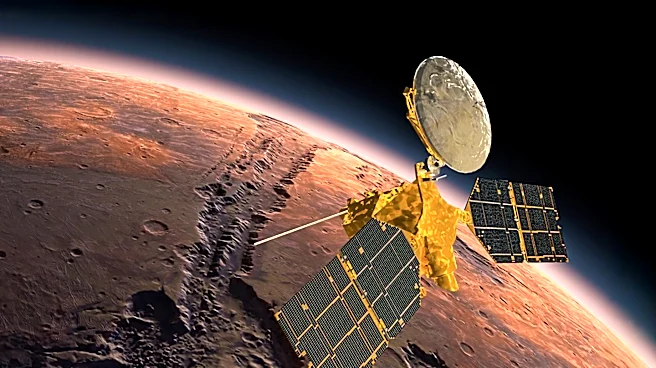
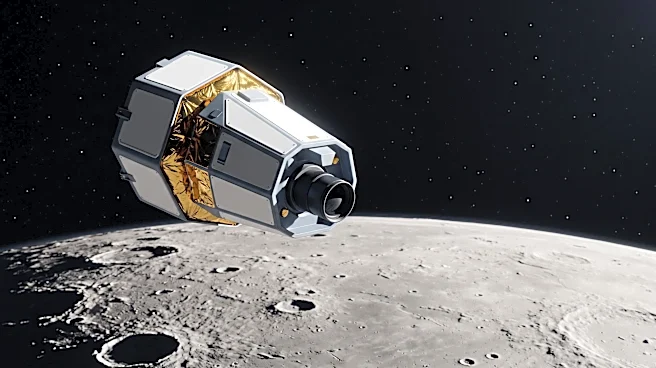
of remotely mapping minerals on celestial bodies such as the Moon, near-Earth asteroids, and Mars’ moon Phobos. The concept proposes using a single remote-sensing instrument on a small spacecraft to visit multiple locations and scan their surfaces. The primary technology under investigation is Raman spectroscopy, a method already employed by NASA’s Perseverance mission for close-range mineral and water detection on Mars. The challenge for this new concept is to determine if Raman spectroscopy can be effectively used from orbital distances of 30-50 kilometers, significantly greater than previous remote tests which reached about 120 meters. The project has received up to $175,000 for nine months to study critical parameters, including photon detection, laser systems, instrument pointing, and spacecraft propulsion and orbits.
Why It's Important?
Accurate mapping of resource distribution on other worlds is crucial for future space exploration and potential resource utilization. As Sobron noted, landing in an unsuitable location can jeopardize an entire exploration program due to the high costs and risks involved. This project could significantly reduce such risks by providing detailed mineral composition data, enabling more informed landing site selections for future missions. The ability to conduct such surveys from orbit or during flybys would offer a cost-effective and efficient way to scout multiple celestial bodies. If successful, this technology could support long-term human presence beyond Earth by identifying potential sources of water, building materials, and other essential resources, thereby enhancing the sustainability and success of future lunar and Martian missions, as well as asteroid mining endeavors.
What's Next?
Following the nine-month Phase I study, the research team plans to apply for a two-year NIAC Phase II funding. This next stage would allow for further development and refinement of the concept, potentially leading to the design and prototyping of the proposed remote-sensing instrument and spacecraft systems. Successful completion of these phases could position the Interworld Slingshot Resource Surveys concept as a candidate for a future Discovery-class mission. The ongoing research will focus on overcoming the technical challenges associated with detecting extremely weak Raman scattering signals from significant distances, which is critical for the viability of the mission. Future work will also involve detailed simulations and laboratory experiments to validate the theoretical models and instrument designs.
Beyond the Headlines
This initiative represents a broader strategic shift in space exploration towards more efficient and resource-conscious mission planning. By focusing on remote resource mapping, NASA and its partners are laying the groundwork for a future where space missions are not only about scientific discovery but also about practical sustainability. The development of advanced remote sensing techniques like orbital Raman spectroscopy could revolutionize how we approach planetary science and astrobiology, allowing for comprehensive surveys of vast areas without the need for costly and complex lander missions for initial reconnaissance. This could also spur innovation in related fields, such as miniaturized spacecraft technology and advanced data processing algorithms, ultimately making deep space exploration more accessible and economically viable for both governmental agencies and private enterprises.