





What's Happening?
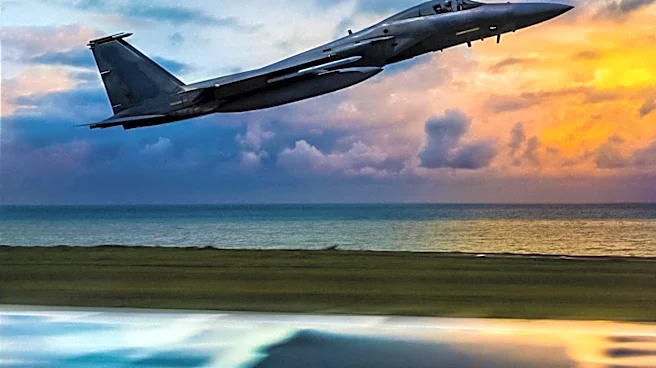
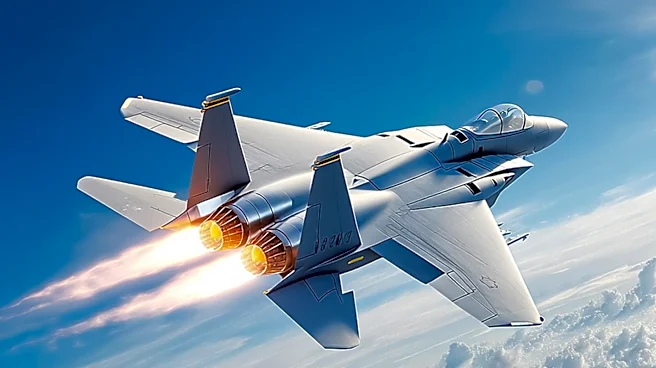
The United States Air Force (USAF) has successfully integrated the Australian MQ-28 Ghost Bat, an uncrewed tactical jet, with its new Boeing F-15EX Eagle II fighters during the Valiant Shield exercises in the Pacific. This exercise, which took place over
the Philippine Sea, is part of the USAF's efforts to develop tactics and procedures for the next evolution of airpower, focusing on human-machine teaming. The MQ-28 operated from the Northern Mariana Islands for ten days, demonstrating its capability to work alongside crewed fighter platforms. The exercise also included a proof-of-concept operation where the MQ-28 was refueled on the ground by a Lockheed Martin HC-130J special mission transport at a forward arming and refueling point. This collaboration highlights the potential of uncrewed systems to act as force multipliers, extending the reach and effectiveness of human pilots.
Why It's Important?
The integration of the MQ-28 with the F-15EX represents a significant advancement in military aviation, showcasing the potential of autonomous systems to enhance combat capabilities. This development is crucial for the USAF as it seeks to maintain air superiority and adapt to modern warfare's evolving demands. The use of uncrewed systems like the MQ-28 can reduce risks to human pilots and increase operational flexibility. Additionally, the collaboration with the Royal Australian Air Force and Boeing underscores the importance of international partnerships in defense technology development. The successful demonstration of these capabilities could lead to broader adoption of autonomous systems in military operations, potentially reshaping air combat strategies and force structures.
What's Next?
Following the successful integration of the MQ-28 with the F-15EX, the USAF is likely to continue refining its tactics and procedures for human-machine teaming. Future exercises may involve more complex scenarios and additional platforms, further testing the capabilities of uncrewed systems. The USAF's Experimental Operations Unit, which participated in the Valiant Shield exercises, will likely play a key role in evaluating and integrating these systems into existing tactical fighter squadrons. As the MQ-28 progresses from a test asset to a viable combat platform, the USAF and its partners will focus on developing advanced models with enhanced features, such as new wing shapes and internal weapons bays, to meet frontline service requirements.