








What's Happening?
UK startup Shield Space is developing swarms of up to 100 autonomous, low-cost cubesats designed to defend Western satellites in Earth orbit. These microwave-sized spacecraft, released by a car-sized carrier, will act as interceptors using 'effectors'
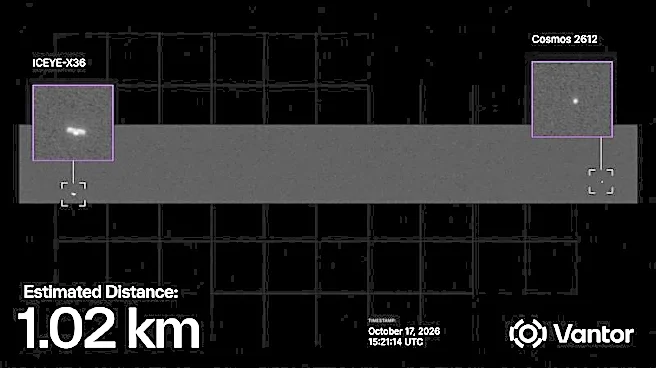
like lasers or microwaves, or 'kinetic standoff' techniques, to protect satellites even if ground control is lost. This initiative is directly influenced by the lessons learned from drone warfare in Ukraine, where low-cost autonomous drones have proven effective. The company plans an aggressive schedule of missions, including Project Broadsword in Q4 2027, to demonstrate rendezvous and proximity operations (RPO) with two small spacecraft, aiming for near-full autonomy. This development follows incidents in May and October 2026 where Russian military satellites approached a private synthetic aperture radar satellite, ICEYE-X36, believed to be providing intelligence for Ukraine, raising concerns about orbital warfare tactics.
Why It's Important?
This development signifies a critical shift in orbital warfare capabilities, moving towards more autonomous and distributed satellite defense systems. The ability to deploy swarms of low-cost, attritable cubesats could significantly enhance the resilience of Western satellite infrastructure against potential adversarial actions, such as jamming, blinding with lasers, or kinetic attacks. For the U.S. and its allies, this technology could provide a more robust and cost-effective defense mechanism for vital intelligence, communication, and navigation satellites. The emphasis on autonomy means these defense systems could operate effectively even in contested environments where traditional communication with ground control might be compromised. The economic implications include a potential boom in the space defense industry, with companies like Shield Space offering solutions that are significantly cheaper than traditional bespoke satellite designs, making advanced space defense more accessible.
What's Next?
Shield Space plans to conduct its first RPO demonstration, Project Broadsword, in the fourth quarter of 2027, involving an 8U cubesat and a 3U target craft. This will test the ability of the spacecraft to maneuver autonomously from 100 kilometers to within 100 meters. Following this, the company aims to test full-sized 16U cubesats, then a carrier of 10 such cubesats, and eventually a 'super carrier' of 10 carriers deployed across multiple orbits. This progression is intended to lead to a 'space-based carrier strike' capability, offering the ability to protect and defend entire orbits. The success of these demonstrations will be crucial for attracting further investment and proving the viability of swarm combat in space, potentially leading to widespread adoption of such defensive technologies by Western nations.
Beyond the Headlines
The concept of autonomous drone swarms in space raises profound ethical and legal questions regarding the future of warfare. The increasing autonomy of these systems, particularly those capable of kinetic actions, necessitates clear rules of engagement and international agreements to prevent unintended escalation or miscalculation. The challenge of training AI models for space warfare, where real-world data is scarce, highlights the reliance on synthetic data and the need for extensive testing, which itself carries risks, such as creating orbital debris. This technological advancement could also trigger an arms race in space, as nations seek to develop both offensive and defensive capabilities, potentially destabilizing the current space environment. The shift towards low-cost, attritable systems also changes the calculus of conflict, making it easier to deploy and potentially lose assets without incurring prohibitive costs, which could lower the threshold for engagement in space.