
What's Happening?
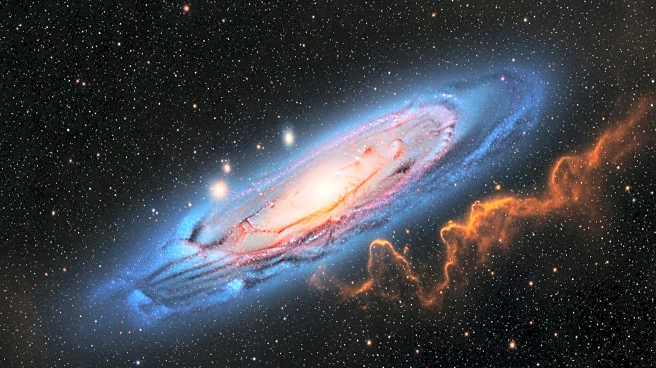
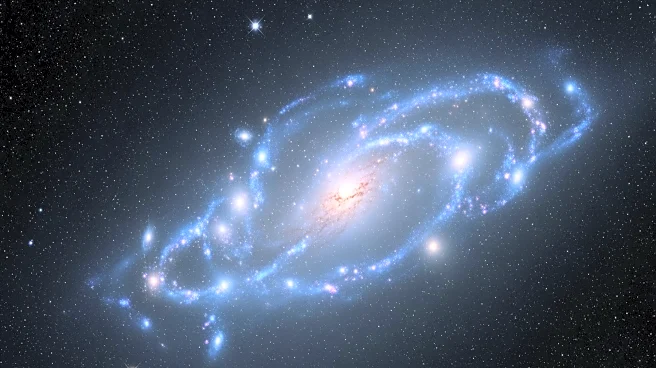
Researchers at the Cosmic Dawn Center, Niels Bohr Institute, University of Copenhagen, have observed an early, massive galaxy cluster with unexpectedly large amounts of cold, neutral hydrogen gas. This finding challenges existing models that predicted
such gas should have been ionized about one billion years after the Big Bang. The study suggests that galaxy cluster evolution and the timeline of cosmic ionization may differ from previous assumptions. The researchers observed a very high density of cold, neutral hydrogen gas, which is still actively forming stars and galaxies within the cluster.
Why It's Important?
This discovery is important as it suggests that the largest structures in the Universe have a different history than previously thought. The presence of cold, neutral hydrogen gas in such large quantities contradicts existing models of the Universe's evolution, which assumed that galaxy clusters would have ionized gas due to the light or radiation from luminous galaxy clusters. This finding could lead to a reevaluation of the processes driving the last phase transition in the Universe's evolution, known as the large-scale ionization of the Universe.
What's Next?
Researchers plan to investigate this question further by observing other galaxy clusters. They aim to understand why there is a larger proportion of cold, neutral hydrogen gas remaining than models predicted at this point in the Universe's history. Future studies will focus on detecting similar structures and understanding their evolution, which could provide new insights into the early Universe and the formation of galaxy clusters.