






What's Happening?
Skanska, a global construction and development firm, has secured a $114 million design-build contract from the District Department of Transportation (DDOT), in collaboration with the Federal Highway Administration (FHWA). This contract is for the rehabilitation
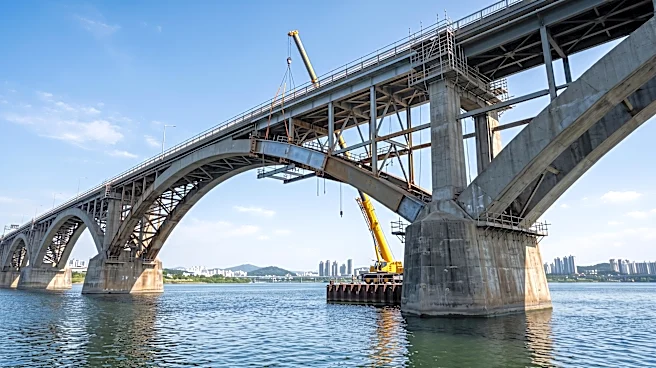
of the I-395 Northbound bridge over the Potomac River, which connects Arlington, Virginia, to Washington, D.C. The bridge, built in 1950 and known as the Arland D. Williams Jr. Memorial Bridge, is a critical .46-mile, four-lane route that accommodates approximately 90,000 vehicles daily. The project aims to extend the bridge's service life by an additional 75 years. Skanska's scope of work includes replacing the bascule piers' vessel protection system and bridge barrier to meet MASH collision requirements, rehabilitating the approach spans' superstructure and substructure, and replacing secondary bridge components. A significant part of the renovation involves converting the current 175-foot-long double-leaf bascule span bridge into a fixed span bridge using accelerated bridge construction (ABC) techniques during a 56-hour weekend shutdown to minimize traffic disruption. Design is scheduled to commence in August 2026, with construction beginning in early 2027. The project team includes AECOM and Genesis Structures.
Why It's Important?
This infrastructure project is vital for the Capital Region's transportation network, addressing critical issues of safety, efficiency, and reliability on a heavily trafficked route. The I-395 Northbound bridge serves as a key artery for commuters and freight traffic between Virginia and Washington, D.C. Its rehabilitation will alleviate traffic bottlenecks, improve travel times, and enhance safety for thousands of daily users. The investment of $114 million underscores the ongoing commitment to upgrading aging infrastructure in the U.S., which is crucial for economic productivity and public safety. The use of accelerated bridge construction (ABC) techniques highlights an innovative approach to minimize disruption, demonstrating a focus on efficient project delivery. For Skanska, this contract reinforces its position as a leading infrastructure developer in the U.S. and contributes to regional job creation and economic activity in the construction sector.
What's Next?
The project will move forward with the design phase beginning in August 2026, followed by the commencement of construction in early 2027. Skanska, along with its partners AECOM and Genesis Structures, will be responsible for executing the detailed design and construction plans. A key aspect of the construction phase will be the implementation of the 56-hour weekend shutdown for the conversion of the bascule span to a fixed span, which will require meticulous planning and coordination to minimize traffic impacts. Local commuters and transportation authorities will need to prepare for potential temporary traffic adjustments during this period. The successful completion of this project will serve as a model for future infrastructure rehabilitation efforts, particularly in densely populated urban areas where minimizing disruption is paramount. The project's progress will be closely monitored by DDOT, FHWA, and the public, given its significance to regional mobility.
Beyond the Headlines
The rehabilitation of the I-395 Northbound bridge is more than just a construction project; it represents a broader national imperative to address the challenges posed by aging infrastructure across the United States. Many bridges and roadways built in the mid-20th century are now reaching the end of their intended lifespans, necessitating significant investment and innovative engineering solutions. This project's focus on extending the bridge's service life by 75 years highlights a long-term vision for sustainable infrastructure development. The conversion from a bascule (movable) bridge to a fixed span also reflects evolving transportation needs and priorities, potentially indicating a shift away from waterway navigation requirements in favor of continuous vehicular flow. Furthermore, the collaboration between DDOT and FHWA underscores the importance of federal and local partnerships in funding and executing large-scale infrastructure improvements that benefit regional and national economies.