







What's Happening?
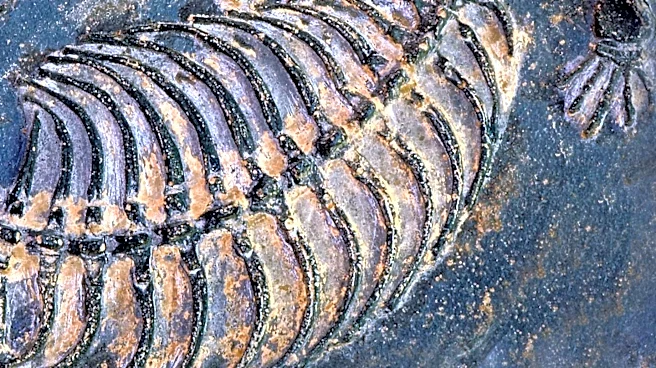
Yunnanozoon lividum, a fossil from the Early Cambrian Chengjiang biota in southwest China, is providing new insights into the origins of vertebrates. This small, soft-bodied organism, dating back approximately 518 million years, is considered a critical
link in the evolutionary chain leading to vertebrates. Recent studies have highlighted its anatomical features, such as a notochord, gill bars, and segmented musculature, which are indicative of early chordate characteristics. The fossil was first described in the early 1990s and has since been a subject of debate regarding its classification. Recent analyses suggest it may be closely related to early vertebrates, offering a glimpse into the evolutionary transition from simple bilaterian ancestors to more complex chordates.
Why It's Important?
The discovery and analysis of Yunnanozoon lividum are significant for understanding the early stages of vertebrate evolution. By providing evidence of chordate-like traits in such an ancient organism, this fossil helps clarify the evolutionary path that led to the development of vertebrates, including humans. The exceptional preservation of soft tissues in the Chengjiang deposits allows scientists to study features rarely seen in fossils, making Yunnanozoon one of the best early chordate fossils available. This research not only fills gaps in the evolutionary timeline but also enhances our understanding of the morphological innovations that occurred during the Cambrian explosion, a period marked by rapid diversification of life forms.