


What's Happening?
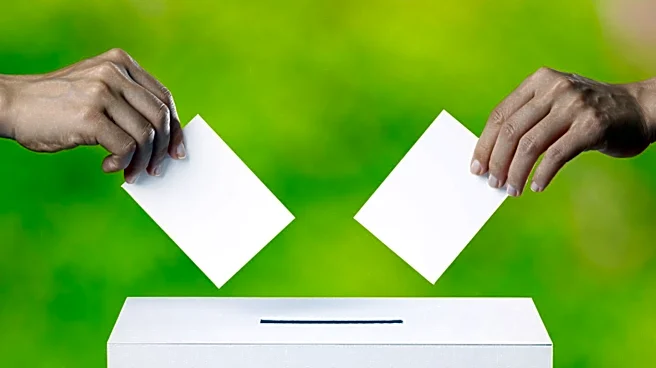
An open primary is a preliminary election where registered voters can select a party's nominee without needing to declare their own party affiliation. This system contrasts with a closed primary, which restricts participation to registered party members.
The open primary model emphasizes voter accessibility and neutrality, allowing individuals to choose a ballot privately on election day. Each party's primary ballot is available to any eligible voter who requests it. This framework is typically established at the state level, with federal guidelines overseeing election conduct. The Advanced Placement curriculum for Government and Politics defines an open primary as an election "in which any voter, regardless of party affiliation, may vote for candidates of any party." This definition focuses on the procedural aspect of voter eligibility rather than philosophical justifications, providing a clear baseline for understanding its operation within the electoral system.
Why It's Important?
The open primary system holds significant importance for American democracy by promoting broader voter engagement and fostering competition among political parties. Proponents argue that it increases voter turnout by removing party registration as a barrier, thereby broadening political discourse beyond partisan bases. This system can also exert a moderating influence on candidates, as they must appeal to a wider spectrum of voters, including independents and members of opposing parties, potentially reducing the power of extreme factions within a party. Historically, the shift towards government-run open primaries represents a move towards democratizing the candidate selection process, which was once controlled by private caucuses. However, critics point to potential disadvantages, such as 'raiding,' where opposing party members might vote to nominate a weaker candidate in another party's primary, and the potential for voter confusion regarding ballot selection and its implications. The system also tends to marginalize independent or third-party candidates who do not have their own primaries, as voters are often compelled to choose between Democratic and Republican options.
What's Next?
The implementation of open primaries varies across states, with different models attempting to balance inclusivity and party integrity. One common variation is the semi-open primary, where voters choose a party's ballot privately but cannot vote in multiple primaries. Another model is the top-two primary, as seen in California, where all candidates, regardless of party, run against each other, and the top two vote-getters advance to the general election, even if from the same party. The ongoing debate surrounding these variations suggests that states will continue to experiment with electoral rules to optimize voter participation and candidate selection. Future discussions may focus on addressing the criticisms of open primaries, such as strategic voting and the marginalization of third parties, while preserving the benefits of increased voter engagement and candidate moderation. The legal landscape, influenced by landmark cases like Tashjian v. Republican Party of Connecticut (1986), will continue to shape how states balance party autonomy with voter access.
Beyond the Headlines
The open primary system has deeper implications for the political landscape, influencing the types of candidates who succeed and the nature of political campaigns. Candidates in open primary states often adopt more centrist rhetoric during the general election, having already demonstrated an ability to attract moderate voters. This dynamic can lead to the nomination of more unconventional candidates who might not thrive in a traditional, party-controlled process. Furthermore, open primaries can serve as a mechanism for expressing political discontent, allowing voters to influence the opposition's choice if they are dissatisfied with their own party's standard-bearer. This system underscores the evolving relationship between political parties, voters, and the state in the democratic process. Understanding the mechanics of the primary system is crucial for civic engagement, as it dictates the starting line of the general election and shapes the subsequent political race, impacting policy outcomes and representation.