



What's Happening?
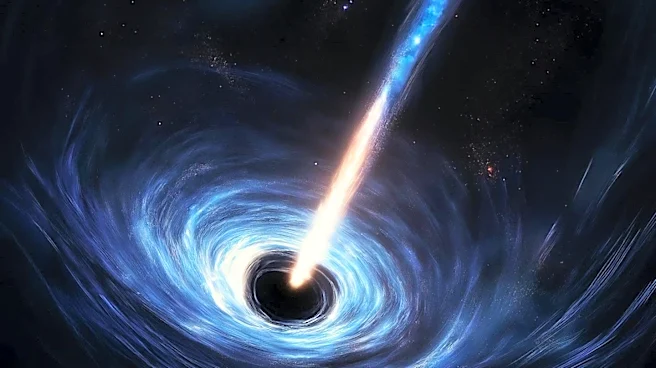
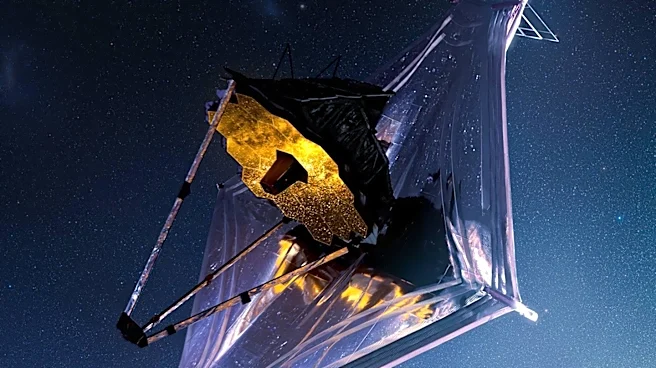
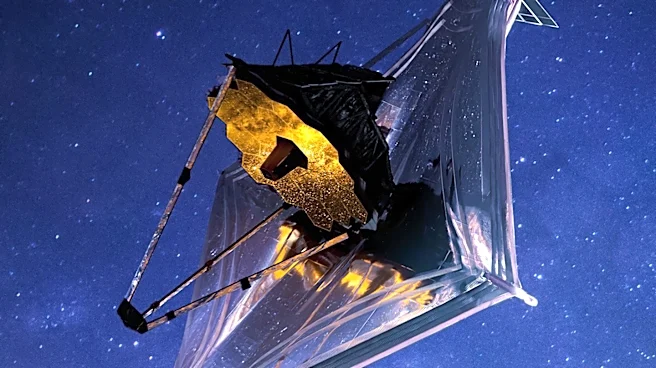
The James Webb Space Telescope (JWST) has made a significant discovery, identifying an object 660 million years after the Big Bang that appears star-like but is 100 billion times brighter than any star. This object, dubbed a 'black hole star,' is theorized
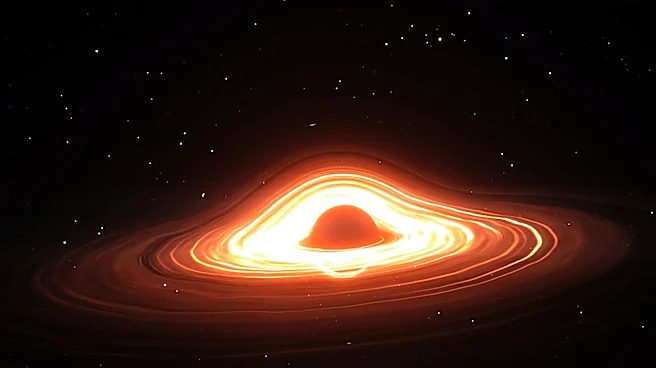
to be a supermassive black hole enveloped in a dense, dust-free gas cloud. Unlike conventional stars powered by nuclear fusion, this 'black hole star' emits colossal energy from the black hole at its core. This finding emerged from observations of 'Little Red Dots' (LRDs) in the early universe, which have puzzled astronomers since their discovery. Researchers, including Rohan Naidu from the University of Hawai’i’s Institute for Astronomy, propose that these LRDs could be such black hole stars, offering a potential explanation for the unexpectedly massive supermassive black holes observed in the very early universe. The spectroscopic analysis of this object, MoM-BH*-1, revealed a deep Balmer break and multi-peaked Hβ emission, indicating an extremely dense hydrogen envelope rather than a dusty accretion disk.
Why It's Important?
This discovery is crucial for understanding the formation and rapid growth of supermassive black holes in the early universe, a phenomenon that has long puzzled scientists. Current theories struggle to explain how black holes could have reached such immense sizes within the first 700 million years after the Big Bang. The 'black hole star' model suggests a mechanism for rapid growth through super-Eddington accretion, where a black hole accretes matter at a rate exceeding the theoretical maximum. If confirmed, this could revise our understanding of cosmic dawn and the evolution of galaxies. It also implies that previous mass estimations for some early universe objects, particularly LRDs, might have been significantly overestimated. The existence of these 'black hole stars' could provide the 'heavy seeds' necessary for the formation of the supermassive black holes observed today, offering a new pathway for their early development.
What's Next?
Further observations of similar objects are needed to confirm the 'black hole star' hypothesis and its implications for early universe cosmology. Researchers will likely focus on identifying more 'Little Red Dots' with similar spectroscopic signatures to MoM-BH*-1. The ongoing analysis of JWST data is expected to yield more candidates for these 'black hole stars,' allowing for a more comprehensive study of their properties and distribution. This will involve refining theoretical models of black hole growth and accretion to incorporate the new findings. The scientific community will also be working to understand the transition from these gas-enshrouded black holes to the more commonly observed quasars and active galactic nuclei. The potential merger of MoM-BH*-1 with a nearby galaxy within approximately 100 million years also presents an opportunity for future studies on black hole interactions and galaxy evolution.
Beyond the Headlines
The concept of a 'black hole star' challenges the traditional distinction between stars and black holes, suggesting a new category of celestial objects. This discovery highlights the dynamic and often unexpected nature of the early universe, where extreme conditions led to phenomena not readily observed today. It underscores the power of advanced telescopes like JWST to reveal previously unknown aspects of cosmic history, pushing the boundaries of astrophysical understanding. The 'black hole star' model also raises questions about the interplay between black holes and their host galaxies, particularly in the context of early galaxy formation. The idea that black holes could be 'enshrouded' in dense gas, rather than just having an accretion disk, offers a novel perspective on how these cosmic giants interact with their immediate environment and influence the evolution of the universe.