







What's Happening?
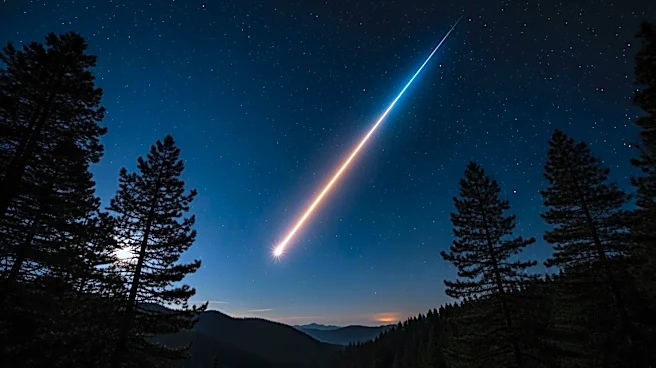
A bright fireball was observed streaking across the night sky over the Pacific Northwest on April 29, capturing the attention of over 150 people across Oregon, Washington, and British Columbia. The American Meteor Society reported at least 151 sightings
of the meteor, which was seen shortly after midnight. Eyewitness accounts and video submissions indicate that the meteor was traveling southwest at an estimated speed of 66,000 miles per hour before disintegrating over the Pacific Ocean. The event was characterized by vivid flashes of orange, blue, and green, colors that are typically associated with the meteor's chemical composition and its interaction with Earth's atmosphere. According to Jim Todd, director of space science education at OMSI, this meteor was likely a sporadic one, not linked to any known meteor shower, despite the ongoing Lyrid meteor shower.
Why It's Important?
The sighting of the meteor is significant as it provides a rare opportunity for scientific observation and public engagement with astronomical phenomena. Events like these help researchers at organizations such as the American Meteor Society to gather data on meteors' paths and compositions, contributing to a better understanding of these celestial events. For the public, such occurrences spark interest in space science and can inspire educational pursuits in astronomy. Additionally, the vivid display of colors and the meteor's high speed offer insights into the chemical and physical processes occurring as meteors enter Earth's atmosphere, which can have broader implications for studying space weather and its effects on Earth.
What's Next?
The American Meteor Society continues to collect reports and video footage from the event to further analyze the meteor's trajectory and composition. They encourage anyone who witnessed the event or captured it on video to submit their observations to the Society's Fireball Log. This ongoing data collection will aid researchers in refining their understanding of sporadic meteors and their characteristics. As Earth passes through the debris left by Halley's Comet, producing the Eta Aquarid meteor shower, more opportunities for observation and study will arise, potentially leading to new discoveries in meteor science.