





What's Happening?
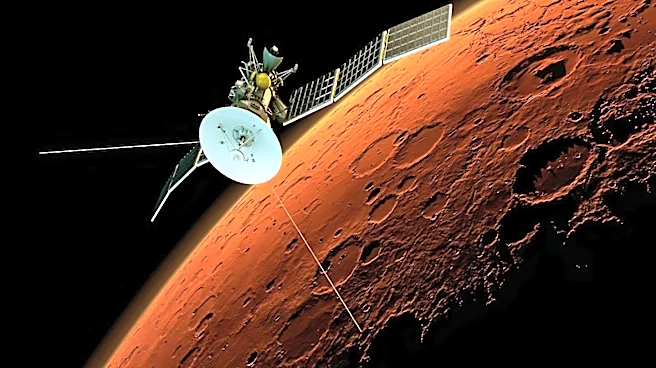
The European Space Agency’s (ESA) Mars Express mission has conducted a detailed flyover of Schiaparelli Crater on Mars. This crater, measuring 460 km across, appears relatively shallow, suggesting it has been filled over billions of years by sediment
from wind, water, lava, or a combination of these elements. The crater is named after Italian astronomer Giovanni Schiaparelli, known for his observations of Mars in 1877. During this period, Schiaparelli mapped the planet and identified straight dark lines, which he called 'canali,' believing them to be natural water-filled channels. This term was misinterpreted as 'canals,' leading to speculation about artificial irrigation by intelligent Martians. Modern understanding, however, attributes these 'canali' to optical illusions from early telescopes. While no water-filled channels exist on Mars today, evidence suggests the presence of water in this region in the past, possibly in the form of a lake. The data for this flyover was processed using the Mars Express High Resolution Stereo Camera (HRSC) data, with systematic processing by the German Aerospace Center (DLR) and film creation by Freie Universität Berlin.
Why It's Important?
The exploration of Schiaparelli Crater by Mars Express provides crucial insights into the geological and hydrological history of Mars. Understanding how the crater became shallow through infilling processes helps scientists reconstruct the planet's past environmental conditions, including the presence of water, which is vital for assessing Mars's potential for past or present life. The historical context of Schiaparelli's 'canali' also highlights the evolution of scientific understanding and the impact of technological advancements (from early telescopes to modern orbital cameras) on our perception of other planets. This research contributes to the broader scientific endeavor of planetary science, informing future missions to Mars and enhancing our knowledge of planetary formation and evolution within our solar system. The data gathered from such missions is fundamental for developing more accurate models of Martian climate and geology.
What's Next?
The ongoing analysis of data from the Mars Express mission, particularly from areas like Schiaparelli Crater, will continue to refine our understanding of Martian geology and the history of water on the planet. Scientists will likely use this information to identify other potential sites for past water activity and to guide future Mars missions, including those focused on astrobiology and the search for biosignatures. The detailed topographical and compositional data from the HRSC will be integrated into global Martian maps and models, providing a more comprehensive picture of the planet's surface. Further research may also involve comparing these findings with data from other Mars orbiters and rovers to build a more complete narrative of Mars's environmental evolution.
Beyond the Headlines
The story of Schiaparelli Crater and its 'canali' offers a compelling example of how scientific interpretations can evolve with improved technology and understanding. It underscores the importance of critical analysis and the potential for misinterpretation when observing phenomena at the limits of current technological capabilities. Beyond its scientific significance, Schiaparelli Crater holds cultural importance, notably as the final destination of astronaut Mark Watney in 'The Martian,' illustrating how scientific discoveries and locations can inspire popular culture and engage a wider audience in space exploration. This interplay between science and popular imagination can further fuel public interest and support for space missions, driving continued investment in planetary research and exploration.