








What's Happening?
Interpol announced that an international operation targeting environmental crime across Latin America and the Caribbean resulted in 233 arrests. The two-month operation, named Madre Tierra VIII, focused on illegal logging, gold mining, and wildlife trafficking
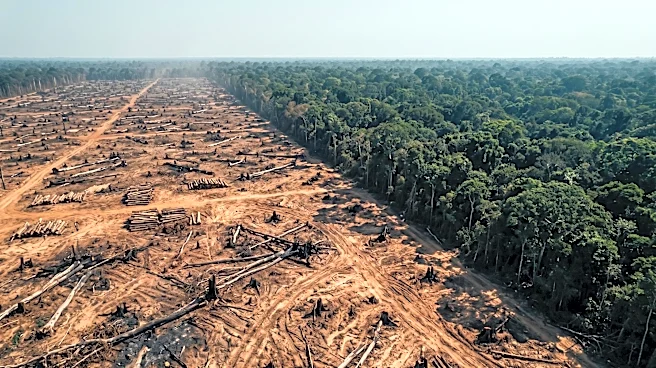
across nine countries: Colombia, Costa Rica, the Dominican Republic, El Salvador, Guatemala, Honduras, Mexico, Nicaragua, and Panama. Investigators identified approximately 60,000 hectares of illegally cleared forest, an area ten times the size of Manhattan. The operation also uncovered extensive links between large-scale Amazon deforestation and companies operating across several continents. Authorities recovered over 1,000 live animals, including endangered species like Bengal tigers, lions, jaguars, ocelots, parrots, and macaws. Additionally, 165 kilograms of dried shark fins, valued at an estimated $280,000, were seized. The investigation extended beyond individuals directly involved in illegal activities to target the financial networks, shell companies, and international buyers profiting from environmental destruction. In one case originating in Colombia, intelligence gathered during the operation linked 11 foreign companies suspected of clearing over 52,000 hectares of protected Amazon forest to an additional 161 companies and 65 individuals across multiple continents.
Why It's Important?
This Interpol operation highlights the growing sophistication and transnational nature of environmental crime, demonstrating its deep connections with organized crime. By focusing on financial networks and corporate entities, authorities are shifting strategies to dismantle the entire illicit supply chain, rather than just targeting low-level perpetrators. The scale of deforestation and wildlife trafficking uncovered underscores the severe ecological impact on biodiversity-rich regions, particularly the Amazon, which is crucial for global climate stability. The involvement of companies and financial mechanisms across continents indicates that consumers and businesses in North America, Europe, and Asia may unknowingly or knowingly be contributing to these crimes. The seizure of large quantities of chemicals like cyanide and mercury also points to the significant environmental pollution caused by illegal gold mining, which contaminates rivers and ecosystems. This crackdown serves as a critical step in protecting endangered species and vital natural resources, while also exposing the complex web of illicit activities that fuel environmental degradation.
What's Next?
Following the arrests and seizures, Interpol has issued international notices, including Red, Blue, and Purple Notices, to assist authorities in identifying, locating, and apprehending suspects linked to these environmental crime networks. The intelligence gathered during Operation Madre Tierra VIII will likely lead to further investigations and prosecutions across multiple jurisdictions, as authorities continue to trace financial flows and corporate links. The focus on financial trails, as emphasized by Krandall Gullock, head of Interpol’s Regional Bureau for Central America, suggests a sustained effort to target the ultimate beneficiaries of these crimes. Future operations are expected to build on the insights gained, aiming to disrupt the funding and management structures that enable large-scale environmental destruction. Continued international cooperation and information sharing among law enforcement agencies will be crucial for dismantling these complex transnational criminal organizations and bringing those responsible to justice.
Beyond the Headlines
The operation reveals a deeper entanglement of environmental crime with broader illicit economies, as some wildlife trafficking routes were found to overlap with those used for drug and other illicit goods. This convergence suggests that criminal organizations are diversifying their portfolios, exploiting natural resources for profit alongside traditional illegal activities. The use of shell companies and foreign investment mechanisms highlights vulnerabilities in global financial systems that criminals exploit to launder money and obscure their involvement in environmental destruction. This raises ethical questions for financial institutions and regulatory bodies about their due diligence in preventing such illicit flows. Furthermore, the demand for illegally sourced commodities in international markets, particularly in North America, Europe, and Asia, underscores the global responsibility in addressing these crimes. Tackling environmental crime effectively will require not only law enforcement efforts but also consumer awareness, corporate accountability, and stronger international regulations to curb the demand and financial facilitation of these destructive practices.