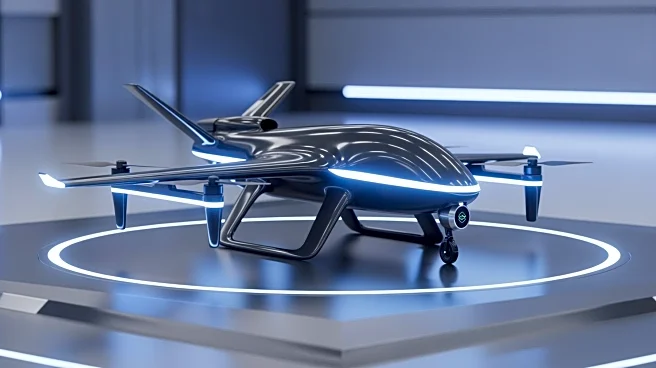

What's Happening?
The GoAERO Prize is a multi-year competition aimed at developing autonomous aircraft for emergency response, with a focus on creating vehicles that can operate in areas inaccessible to traditional helicopters
or ambulances. The competition, supported by major aerospace companies like NASA, Boeing, and Honeywell, has attracted nearly 200 teams from 85 countries. Currently, eight finalists have been selected to advance to the next stage, showcasing innovative designs such as electric tilt-wings and multi-rotor heavy lifters. These prototypes are designed to enhance search-and-rescue operations, medical evacuations, and the delivery of critical supplies in disaster zones. The final competition will culminate in a 2027 fly-off at NASA Ames Research Center, where the overall champion will be determined.
Why It's Important?
The development of autonomous rescue aircraft has significant implications for emergency response capabilities. These vehicles promise to extend the reach of first responders, allowing them to access remote or hazardous areas quickly and efficiently. This could lead to faster medical interventions and improved outcomes in disaster situations. The competition also fosters innovation in the aerospace industry, encouraging the development of new technologies that could be applied to other sectors. Additionally, the involvement of major aerospace companies highlights the potential for these technologies to be integrated into existing emergency response frameworks, potentially transforming how rescue operations are conducted.
What's Next?
The finalists will continue to refine their prototypes in preparation for the 2027 fly-off, where they will demonstrate their capabilities in real-world scenarios. This stage will test the reliability, autonomy, and performance of the aircraft under challenging conditions. The competition organizers and partners will provide support, including mentoring and access to regulatory guidance, to help teams navigate the path to certification. The success of these prototypes could lead to broader adoption of autonomous aircraft in emergency response, potentially setting new standards for the industry.