




What's Happening?
UCLA scientists have successfully measured the body temperature of the Tyrannosaurus rex, finding it to be approximately 97°F (36°C), a temperature comparable to that of humans. This groundbreaking research, published in Science Advances, utilized a refined
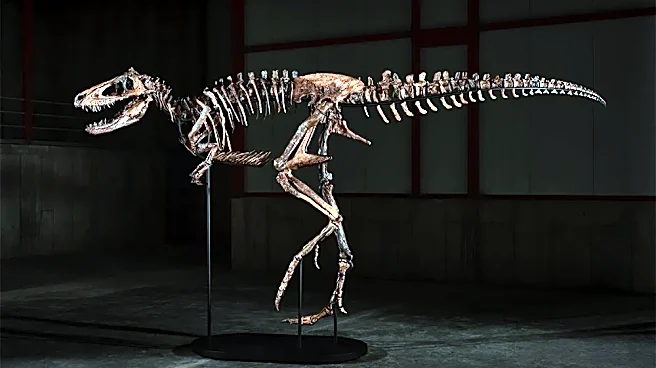
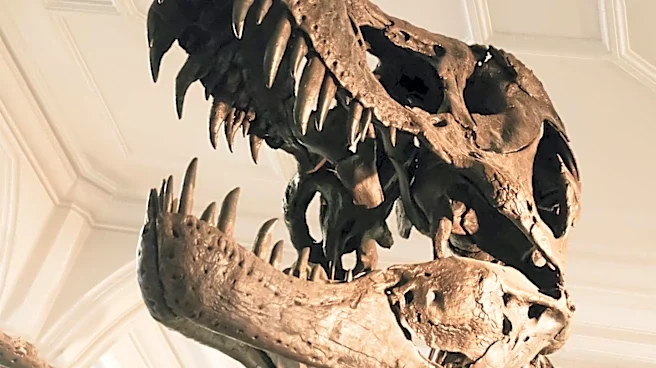
method to analyze the chemical bonds of rare isotopes of carbon and oxygen within fossilized tooth enamel. The number of these bonds decreases in warmer temperatures, allowing researchers to act as a 'geologic thermometer.' The study used small portions of two teeth from 'Thomas the T. rex,' a well-preserved specimen from the Natural History Museum of Los Angeles County. This finding provides empirical evidence supporting theories that T. rex was a warm-blooded, active predator or scavenger, rather than a cold-blooded, slow-moving reptile. The method involved using a dental drill to remove enamel, dissolving the powder in phosphoric acid to release carbon dioxide gas, and then measuring isotope ratios with a mass spectrometer. This advanced technique required significantly less material than previous methods, making it feasible for museum specimens.
Why It's Important?
This discovery significantly impacts our understanding of dinosaur physiology and behavior. Confirming T. rex as warm-blooded suggests it had a fast metabolism, requiring it to be an active hunter or scavenger to fuel its body. This challenges older perceptions of dinosaurs as sluggish, cold-blooded creatures. The ability of a warm-blooded T. rex to maintain a stable internal temperature would have allowed it to thrive in a wider range of environments, including cooler regions like Cretaceous Alaska, where cold-blooded reptiles would have struggled. This is supported by the absence of other reptile fossils in Cretaceous Alaska, while Tyrannosaurus fossils have been found there. The research also highlights the evolutionary path from cold-blooded reptiles to warm-blooded birds, with T. rex representing an intermediate stage. The refined methodology for measuring ancient body temperatures from tooth enamel opens new avenues for paleontological research, enabling scientists to glean more detailed information from limited fossil samples and potentially apply this technique to other extinct species.
What's Next?
The refined method for determining ancient body temperatures from tooth enamel could be applied to a broader range of fossilized species, potentially revealing more about the thermoregulation of other dinosaurs and prehistoric animals. This could lead to a more comprehensive understanding of ancient ecosystems and how different species adapted to varying climates. Future research may focus on comparing the body temperatures of various dinosaur groups to trace evolutionary trends in thermoregulation. Paleontologists might also use this data to refine paleoclimate models, providing more accurate reconstructions of ancient environments and the geographical distribution of species. The success of this non-destructive (or minimally destructive) technique could encourage museums to allow similar analyses on other valuable specimens, further expanding the scope of such studies and contributing to a richer understanding of Earth's prehistoric past.
Beyond the Headlines
This research delves into the fundamental biological characteristics of extinct life, offering insights into the very nature of life's adaptation and evolution. The finding that T. rex maintained a body temperature similar to humans blurs the lines between our modern understanding of 'reptile' and 'mammal' in the context of deep time, suggesting that thermoregulation is a more complex and varied evolutionary trait than often assumed. It underscores the idea that evolution is not a linear progression but a branching, adaptive process. Furthermore, the development of a less invasive method for analyzing precious fossil samples highlights the ethical considerations in scientific research, balancing the pursuit of knowledge with the preservation of irreplaceable artifacts. This scientific advancement also serves as a powerful reminder of how technological innovation can unlock secrets from the distant past, continually reshaping our perception of life on Earth and our place within its vast history.