
What's Happening?
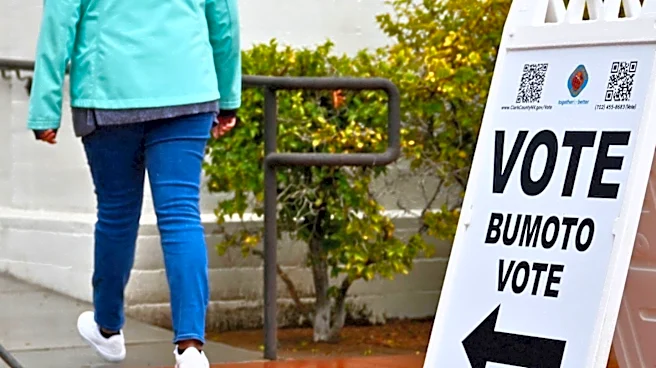
The North Carolina Board of Elections, with its Republican majority, voted along party lines to reject most Sunday early voting hours in counties where local boards could not reach unanimous agreement
on weekend schedules. Republicans on county boards argued against Sunday voting, citing low turnout and the belief that Sunday should be reserved for church and family. Conversely, Democratic members and advocates emphasized that Sunday hours provide crucial access for individuals with irregular work schedules, long commutes, or caregiving responsibilities. The contentious decisions were made amidst revelations that state Auditor Dave Boliek's office, through GOP operative Dallas Woodhouse, had influenced local county decisions on voting locations and hours, urging the removal of Sunday hours.
Why It's Important?
This decision by the North Carolina Board of Elections has significant implications for voter access and the integrity of the electoral process in the state. Limiting Sunday early voting hours disproportionately affects certain demographics, including working-class individuals, minority voters, and those with limited transportation options, who often rely on weekend voting opportunities. The partisan nature of the votes and the alleged influence from the state Auditor's office raise concerns about potential voter suppression and the politicization of election administration. This situation highlights the ongoing national debate over voting rights and the methods used to shape voter turnout, with potential consequences for election outcomes and public trust in democratic institutions.
What's Next?
The approved early voting plans, largely without Sunday hours in contested counties, will be implemented for the upcoming election cycle. Voter advocacy groups and Democratic organizations are likely to challenge these decisions, potentially through legal avenues or by mobilizing voters to cast ballots during the available hours. The controversy surrounding the influence of the state Auditor's office may also lead to further investigations or calls for accountability regarding external interference in local election board decisions. The broader political landscape in North Carolina will continue to be shaped by these voting access debates, with potential impacts on future legislative efforts related to election laws and voter registration.
Beyond the Headlines
This issue extends beyond mere scheduling; it delves into fundamental questions of democratic participation and the philosophical underpinnings of voting access. The argument that Sunday should be reserved for religious observance, while deeply held by some, clashes with the principle of maximizing civic engagement for all citizens. The alleged partisan manipulation of early voting schedules underscores a growing trend in U.S. politics where administrative decisions are used to gain electoral advantage, rather than solely to facilitate voting. This situation could further entrench partisan divisions and erode public confidence in the fairness of elections, prompting a deeper examination of how election boards are structured and the extent of political influence they are subjected to. It also highlights the ongoing struggle to balance religious freedom with the secular administration of public services.