






What's Happening?
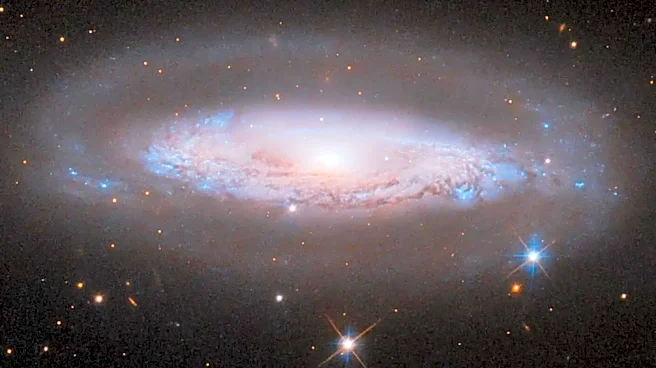
The NASA/ESA Hubble Space Telescope has captured an image of the spiral galaxy NGC 4654, located 72 million light-years away in the Virgo Cluster. This galaxy is classified as an intermediate spiral due to its weak bar structure at the center. NGC 4654 exhibits
a unique asymmetry, with a rounded edge on one side and a long gaseous tail on the other. This tail is a result of ram pressure stripping, a force experienced as the galaxy moves through the hot gas of the Virgo Cluster. The galaxy's stars are also unevenly distributed, with one spiral arm rich in stars and gas, while the opposite arm lacks stars. This unusual distribution is thought to be caused by a past gravitational interaction with another galaxy, NGC 4639, around 500 million years ago. Despite these forces, NGC 4654 continues to form stars at a rate comparable to similar-sized galaxies.
Why It's Important?
The observation of NGC 4654 provides valuable insights into the dynamics of galaxies within clusters and the effects of ram pressure stripping. Understanding these processes is crucial for astronomers studying galaxy evolution and star formation. The continued star formation in NGC 4654, despite the loss of gas, challenges existing theories and suggests that other factors may contribute to sustaining star formation. This research can help refine models of galaxy behavior and improve predictions about the life cycles of galaxies in dense environments like the Virgo Cluster.
What's Next?
Future observations and studies will likely focus on further understanding the mechanisms behind the sustained star formation in NGC 4654. Researchers may also explore the long-term effects of gravitational interactions and ram pressure stripping on galaxy morphology and star formation rates. These studies could involve observing other galaxies in similar environments to compare and contrast their evolutionary paths.