



What's Happening?
NASA has launched a new competition, the Advanced Mid-Power Electric Rocket (AMPERE) Challenge, inviting U.S. companies to develop prototypes of mid-power Hall effect thrusters. This initiative aims to accelerate the maturation of electric propulsion
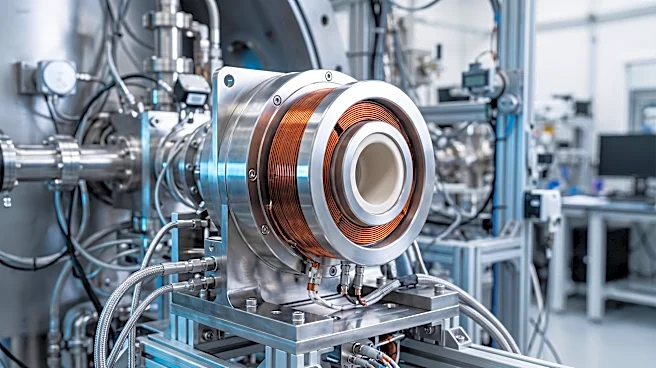
systems, which are considered vital for future space operations and exploration. Hall effect thrusters utilize an electric field to accelerate propellant gas, offering efficient thrust for long-duration missions and reducing propellant consumption by a factor of ten compared to chemical rockets. NASA is offering $500,000, to be split between two winning companies, and will provide access to its subject matter expertise, state-of-the-art technologies, and world-class testing facilities at no cost to the winners. The challenge is the first in NASA’s Tech Maturation Prize series, designed to foster breakthrough technologies and strengthen the U.S. space economy.
Why It's Important?
This challenge is crucial for advancing U.S. capabilities in space exploration and commercial space. Electric propulsion systems, particularly Hall effect thrusters, are essential for missions requiring long-duration travel and efficient use of propellant, such as deploying satellites and deep space robotic vehicles. By incentivizing private companies to innovate in this area, NASA is not only securing critical technology for its own missions but also stimulating growth within the U.S. space industry. The provision of financial awards, expert guidance, and access to advanced testing facilities significantly lowers the barrier to entry for companies, fostering a competitive environment that can lead to rapid technological advancements. This initiative directly supports the U.S. goal of maintaining leadership in space technology and expanding commercial opportunities in the burgeoning space economy.
What's Next?
The AMPERE Challenge is open for registration until January 27, 2027. Interested parties can learn more at an AMPERE Virtual Industry Day hosted by NASA on Thursday, November 19. The competition will proceed in three phases. In Phase 1, participating teams will submit concept designs, manufacturing plans, and cost/performance projections. NASA may select two winners to advance to Phase 2, where they will develop prototypes and collaborate with NASA personnel, potentially gaining access to NASA-developed Hall effect thruster technologies through no-cost licensing. In Phase 3, the prototypes will undergo testing at NASA Glenn Research Center. The two winning teams will each receive up to $250,000. This structured approach aims to guide promising technologies from conceptual design to validated prototypes, paving the way for their integration into future NASA and commercial space missions.
Beyond the Headlines
The development of advanced electric propulsion systems like Hall effect thrusters has broader implications beyond immediate space missions. Increased efficiency in space travel could lead to more ambitious scientific endeavors, such as faster and more frequent robotic missions to distant planets and asteroids, potentially yielding new discoveries about the solar system's origins and the possibility of extraterrestrial life. Furthermore, the commercialization of these technologies could reduce the cost of launching and operating satellites, making space more accessible for various industries, including communication, Earth observation, and resource exploration. This challenge also underscores a strategic shift towards leveraging private sector innovation to achieve national space goals, fostering a dynamic ecosystem where government and industry collaborate to push the boundaries of what's possible in space.