
What's Happening?
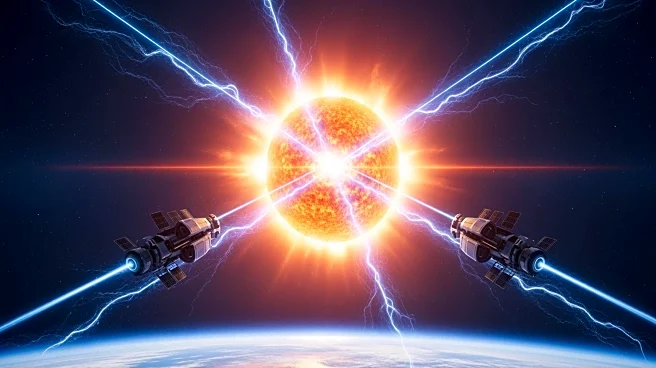
A recent study published in the Monthly Notices of the Royal Astronomical Society has documented a rare cosmic event involving a black hole consuming a massive star, resulting in an explosion of energy
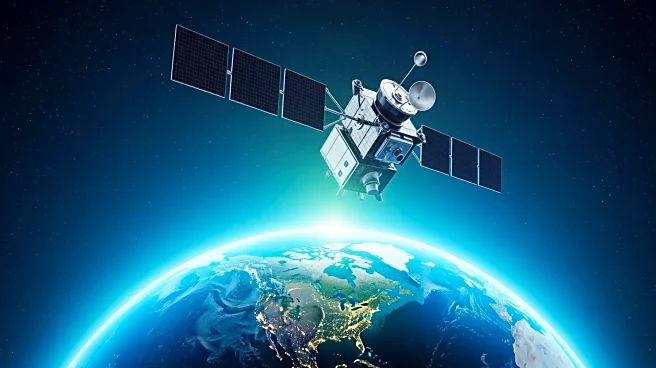
400 billion times greater than the sun's output. This event, named Whippet and officially designated AT2024wpp, was observed using advanced telescopes and space observatories, including the Zwicky Transient Facility and NASA’s Swift satellite. The phenomenon is classified as a Tidal Disruption Event (TDE), where the gravitational forces of a black hole tear apart a star, forming a disk of material that feeds the black hole. The Whippet event is notable for its unprecedented scale, far exceeding the energy of any known supernova. It has been further classified as a Luminous Fast Blue Optical Transient (LFBOT), characterized by extreme luminosity, blue color, and X-ray emissions.
Why It's Important?
The discovery of the Whippet event is significant for the scientific community as it provides new insights into the interactions between black holes and stars. The scale of the energy released challenges existing theories about Tidal Disruption Events and opens new avenues for research into the mechanisms driving such powerful explosions. This event also highlights the capabilities of modern observational tools in capturing rare cosmic phenomena, offering astronomers a new way to study black holes, their formation, and growth. The classification of the event as an LFBOT provides a framework for identifying and studying similar occurrences in the future, potentially leading to a deeper understanding of stellar destruction and black hole dynamics.
What's Next?
Following the Whippet event, astronomers are likely to focus on further analyzing the data collected to refine models of black hole behavior and stellar interactions. The event's classification as an LFBOT may prompt additional studies to explore the characteristics and frequency of such phenomena. Collaborative efforts among observatories and research institutions will continue to be crucial in monitoring and understanding these cosmic events. The findings could influence future observational strategies and the development of new technologies to detect and analyze similar occurrences.
Beyond the Headlines
The Whippet event underscores the importance of international collaboration in astronomical research, as multiple observatories and institutions contributed to its discovery and analysis. It also raises questions about the frequency and distribution of such powerful cosmic events in the universe, potentially impacting our understanding of the lifecycle of stars and the role of black holes in galactic evolution. The event may also inspire public interest in space exploration and the study of the universe, highlighting the awe-inspiring nature of cosmic phenomena.