







What's Happening?
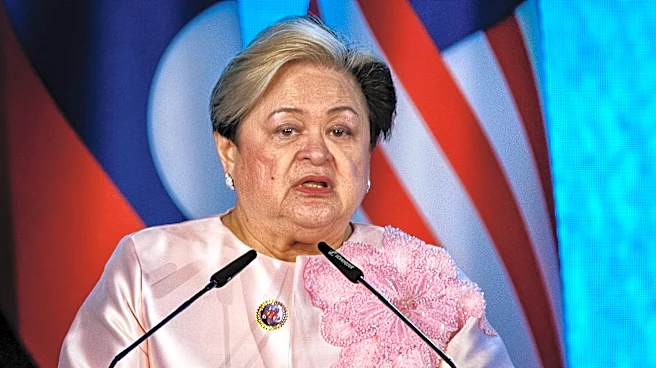
Philippine Foreign Affairs Secretary Ma. Theresa Lazaro, serving as the Association of Southeast Asian Nations (ASEAN)'s special envoy, has concluded a two-day humanitarian mission in Myanmar. Her visit included overseeing aid distribution in Taunggyi,
Shan State, and meeting with Myanmar’s Foreign Minister Tin Maung Swe in Naypyidaw. Discussions focused on the humanitarian situation, access to hard-to-reach communities, and the implementation of ASEAN’s Five-Point Consensus for managing the Myanmar conflict. Lazaro also visited a school and monastery that received Philippine humanitarian assistance following a March 2025 earthquake. Myanmar's Foreign Ministry characterized the meeting as discussions on restoring Myanmar's role within ASEAN, while emphasizing its own efforts to promote peace and stability and address 'terrorism.' This mission is potentially Lazaro's last as special envoy, as Singapore is set to assume ASEAN's chairmanship in 2027.
Why It's Important?
This mission highlights the ongoing challenges ASEAN faces in addressing the humanitarian crisis and political instability in Myanmar following the military coup. The differing interpretations of the meeting by the Philippines and Myanmar underscore the deep divisions and lack of progress on the Five-Point Consensus. Myanmar's military-backed administration has actively sought normalization with ASEAN members while simultaneously rejecting key tenets of the Consensus, such as dialogue among all parties and full humanitarian access. The military's refusal to allow Lazaro to meet with detained former leader Aung San Suu Kyi further demonstrates its reluctance to engage meaningfully with ASEAN's diplomatic efforts, impacting regional stability and human rights. The situation also tests ASEAN's effectiveness as a regional body in resolving internal conflicts among its member states.
What's Next?
Lazaro's tenure as special envoy will end when Singapore takes over ASEAN's chairmanship in 2027, raising questions about the future direction of ASEAN's engagement with Myanmar. The military-backed administration in Myanmar is expected to continue its push for diplomatic normalization while maintaining its stance against the full implementation of the Five-Point Consensus. ASEAN will need to reassess its strategy for Myanmar, potentially exploring new approaches to encourage adherence to the Consensus and address the humanitarian crisis. The international community will likely continue to monitor ASEAN's efforts and the situation in Myanmar, with potential implications for regional security and diplomatic relations.
Beyond the Headlines
The situation in Myanmar and ASEAN's response reveal the complexities of regional diplomacy and the principle of non-interference. While ASEAN aims to foster regional stability, its consensus-based decision-making and respect for national sovereignty can sometimes hinder decisive action in internal crises. The military's selective engagement with ASEAN's initiatives, such as allowing humanitarian aid distribution in controlled areas while rejecting political dialogue, illustrates a strategic effort to gain legitimacy without ceding control. This dynamic raises ethical questions about the balance between humanitarian intervention and national sovereignty, and the long-term implications for democratic governance and human rights within the ASEAN bloc.