







What's Happening?
Researchers have developed electrically tunable plasmonic metasurfaces that enable low-voltage, reversible wavelength modulation for optical communication. This advancement, detailed in a study published in Nature Communications, addresses the challenges
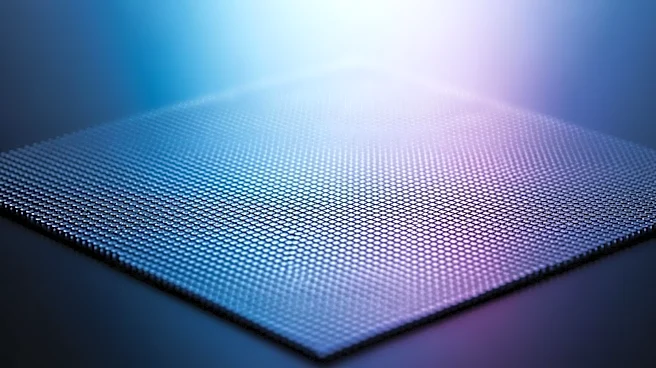
of dynamic tuning in light communication systems, which require compact and tunable optical components. The metasurfaces, composed of periodic metal nanoparticle arrays, utilize surface lattice resonance phenomena to achieve strong light confinement and sharp spectral features. The study introduces a novel approach that combines thermal and Seebeck effects to enable efficient and scalable photonic devices for high-speed, integrated light-based data transmission. The device architecture includes metal nanoparticle lattices fabricated on transparent conductive oxide/quartz substrates, with a thin layer of dimethyl sulfoxide (DMSO) serving as an active optical environment. This setup allows for continuous and reversible wavelength shifts under low CMOS-compatible voltages, enhancing optical modulation performance.
Why It's Important?
The development of these electrically tunable plasmonic metasurfaces is significant for the future of light communication technologies. By enabling low-voltage, reversible wavelength modulation, these devices offer a more efficient and scalable solution for high-speed data transmission. This advancement could lead to the creation of more compact and adaptable optical components, which are crucial for the development of integrated photonic devices such as optical modulators, tunable nanolasers, and photodetectors. The ability to operate at low voltages compatible with standard CMOS electronics also enhances the potential for widespread adoption in various technological applications. This could have a profound impact on industries reliant on high-speed data transmission, such as telecommunications and data centers, by improving the efficiency and scalability of their optical communication systems.
What's Next?
Future research may focus on improving the modulation speed and extending the spectral range of these devices by incorporating materials with stronger thermo-optic or electro-optic responses. Additionally, optimizing resonance modes could further enhance the performance of these metasurfaces. The study's findings open the door for the development of scalable, integrated photonic devices that could revolutionize optical communication technologies. As researchers continue to explore the potential applications of these metasurfaces, we may see advancements in the design of optical modulators, tunable nanolasers, and other photonic devices that leverage the unique properties of these tunable metasurfaces.