
What's Happening?
Astronomers have been investigating a unique gamma-ray burst, GRB 250702B, which lasted seven hours, making it the longest recorded. Detected by NASA's Fermi Gamma-ray Space Telescope, the burst is believed
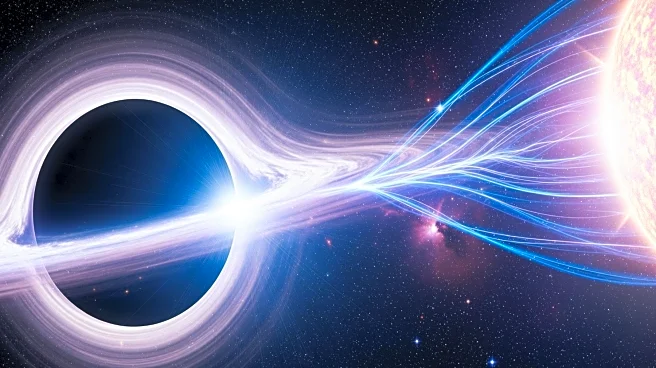
to result from a black hole interacting with a star. The event's unusual duration and characteristics have led scientists to explore several theories, including a black hole merging with a star or a star being torn apart by a black hole. The burst's origin was traced to a distant galaxy, with observations revealing a jet of particles traveling at nearly the speed of light.
Why It's Important?
This gamma-ray burst challenges existing models of such cosmic events, providing a rare opportunity to study the extreme environments where they occur. Understanding these bursts helps scientists explore the conditions under which matter moves at relativistic speeds and the role of black holes in cosmic phenomena. The findings could lead to new insights into the processes that drive gamma-ray bursts and their impact on the universe. This research also highlights the importance of international collaboration in advancing the study of high-energy astrophysics.
What's Next?
Further observations and analyses are needed to determine the exact cause of GRB 250702B. Scientists will continue to study the aftermath of the burst using various telescopes and instruments to gather more data. The event will serve as a benchmark for future gamma-ray burst studies, helping researchers identify similar occurrences and refine theoretical models. As technology advances, astronomers hope to uncover more about the mechanisms behind these powerful explosions and their implications for the universe.