



What's Happening?
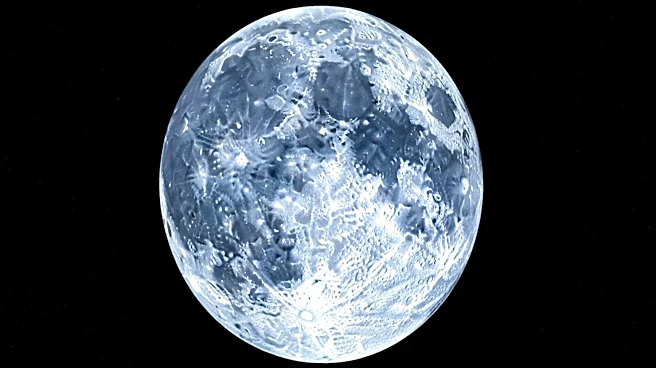
Recent discussions have reignited interest in the Hollow Moon Theory, a fringe belief suggesting that the Moon is hollow and possibly an artificial structure. This theory, which gained traction from fictional works and Cold War-era speculations, posits
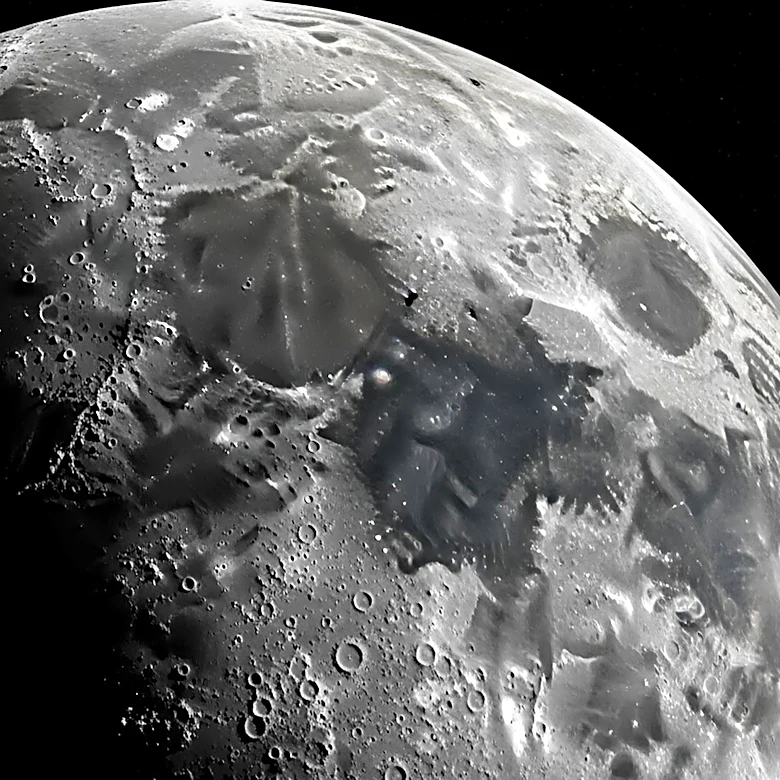
that the Moon's low density indicates a hollow interior. However, astrophysicists have consistently debunked this theory using data from seismology, orbital dynamics, and isotopic analysis. The Moon's density, at 3.34 g/cm³ compared to Earth's 5.51 g/cm³, is explained by its composition rather than void space. Seismic data from Apollo missions and India's Chandrayaan missions confirm a solid mantle and core, with no evidence of hollow anomalies. NASA's GRAIL mission further mapped the Moon's internal mass distribution, revealing dense volcanic rock concentrations, contradicting the hollow theory.
Why It's Important?
The debunking of the Hollow Moon Theory is significant as it reinforces the scientific understanding of lunar geology, which is crucial for future lunar exploration and potential colonization. Understanding the Moon's solid structure is vital for planning sustainable human outposts, as it affects everything from construction to resource extraction. The persistence of such conspiracy theories highlights the challenges scientists face in communicating complex scientific truths to the public. Dispelling myths like the Hollow Moon Theory is essential for fostering public trust in scientific endeavors and ensuring informed support for space exploration initiatives.
What's Next?
As NASA's Artemis program progresses, further missions are planned to explore the Moon's far side and polar regions. These missions aim to provide more detailed seismic data and map the Moon's core in real-time, offering additional evidence of its solid structure. The deployment of advanced instruments will help settle any remaining doubts about the Moon's composition. These efforts are part of a broader strategy to establish a sustainable human presence on the Moon, leveraging its resources for future space exploration. The continued debunking of myths will be crucial in maintaining public interest and support for these ambitious projects.
Beyond the Headlines
The persistence of the Hollow Moon Theory underscores a broader cultural phenomenon where sensationalism often overshadows scientific facts. This reflects a human tendency to favor grand mysteries over mundane realities, which can lead to the proliferation of conspiracy theories. Addressing this issue requires not only scientific evidence but also effective science communication strategies that engage the public's imagination while grounding them in reality. As humanity prepares for a new era of space exploration, fostering a scientifically literate society will be key to overcoming misinformation and ensuring the success of future missions.