
What's Happening?
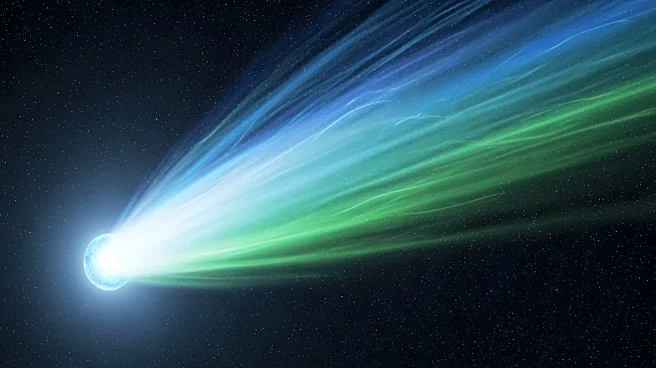
NASA has achieved a significant milestone in space exploration by capturing a 40-day timelapse of Comet C/2025 R2 (SWAN). This mission involved taking images every few minutes, providing an unprecedented
view of the comet's behavior as it interacted with solar wind. The study, conducted from August 25 to October 2, 2025, allowed scientists to observe the comet's tail being pushed away from the Sun, offering valuable insights into the dynamics of space weather. The mission was part of NASA's ongoing efforts to understand the solar system and beyond, with the data gathered expected to enhance knowledge of how solar wind affects comets and, by extension, space weather's impact on Earth.
Why It's Important?
The timelapse study of Comet SWAN is crucial for advancing the understanding of space weather and its effects on both the solar system and Earth. By analyzing how solar wind interacts with comets, scientists can better predict the impact of space weather on technology and astronauts. This research is particularly important for safeguarding satellites, communication systems, and power grids from solar flares and other space weather events. The study also provided a rare opportunity to observe an interstellar object, 3I/ATLAS, which appeared briefly in the timelapse, offering insights into interstellar space phenomena.
What's Next?
The data from this mission will be used to further analyze the interactions between solar wind and comets, potentially leading to improved predictions of space weather effects on Earth. NASA's continued focus on space weather studies will likely involve more missions aimed at understanding the solar system's dynamics, with implications for future space exploration and technology protection. The findings could influence the development of strategies to mitigate the risks posed by space weather to critical infrastructure.
Beyond the Headlines
The study highlights the importance of multi-vantage point observations in space research. By using various instruments to track the comet's movements, NASA was able to gain a comprehensive understanding of the comet's interaction with cosmic forces. This approach could set a new standard for future space missions, emphasizing the need for rapid and detailed observation techniques to capture dynamic space phenomena.