






What's Happening?
The global education sector is facing significant challenges due to protracted conflicts, climate shocks, and tightening public budgets. According to UNESCO, 250 million children are currently out of school worldwide, and progress towards global education goals
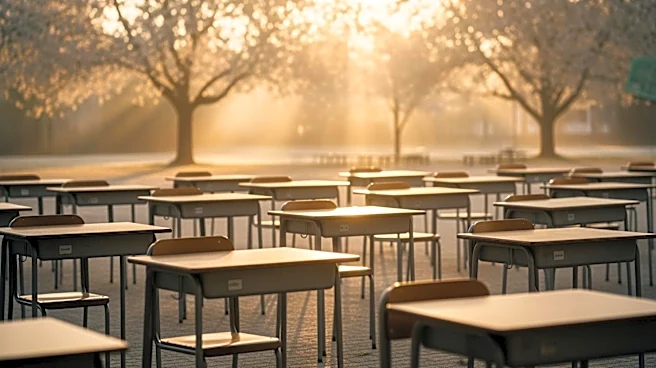
is dangerously off track. UNICEF reports that climate hazards disrupted schooling for at least 242 million students in 85 countries in 2024 alone. Additionally, there have been over 11,000 attacks on schools, students, and education personnel between 2020 and 2023. These disruptions are early warnings of broader political and economic instability. When education systems collapse, it accelerates societal instability, whereas robust systems can aid in faster recovery and economic rebound.
Why It's Important?
Education is not just a moral imperative but a strategic infrastructure essential for societal stability and economic recovery. Interruptions in education lead to long-term consequences, including workforce crises and social cohesion challenges. Families under stress may pull children from school, leading to increased child labor and early marriages. Policymakers are urged to treat education as a strategic response to instability, ensuring systems are resilient enough to operate under pressure. Protecting education budgets is fiscally rational, as the costs of educational collapse include long-term humanitarian dependence and weakened economic growth.
What's Next?
Policymakers are encouraged to design education systems that can withstand disruptions and adapt to current operating environments characterized by conflict and climate disruption. This includes protecting education as essential civilian infrastructure, designing for continuity rather than perfection, and linking learning to economic participation. Sustainable financing and partnerships among governments, international organizations, civil society, and the private sector are crucial for building resilient education systems.
Beyond the Headlines
The broader lesson is that education systems must be treated as strategic infrastructure capable of preventing crises from metastasizing. This requires a commitment to budgeting for education with the understanding that stability is not guaranteed. Countries that build resilient education systems will be better positioned to withstand disruptions and prevent future crises.