


What's Happening?
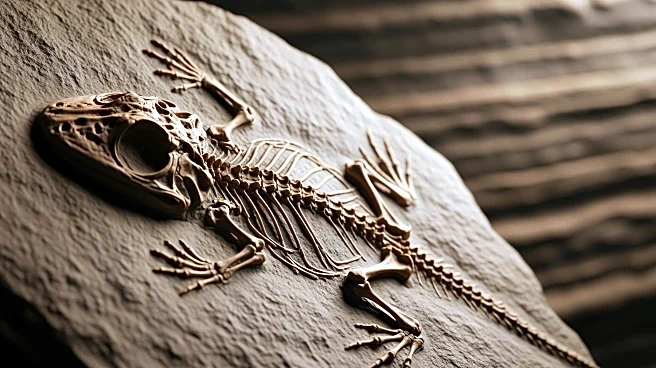
Paleontologists have discovered the fossilized jawbone of Tanyka amnicola, an ancient ancestor of modern salamanders, dating back 275 million years. This creature's jaw features a unique twist and backward-facing teeth, initially thought to be a deformity.
However, further analysis revealed that these features were part of its evolutionary design, suggesting Tanyka was an herbivore, unlike most early tetrapods. The discovery was made by researchers at Chicago's Field Museum, who noted that Tanyka represents a lineage that did not evolve into modern amphibians or reptiles but followed its own evolutionary path.
Why It's Important?
The discovery of Tanyka amnicola provides new insights into the diversity of early vertebrate life and challenges existing theories about tetrapod evolution. By revealing a lineage that maintained unique traits over millions of years, this finding could reshape our understanding of evolutionary processes and the adaptability of ancient species. It highlights the complexity of evolutionary history and the potential for undiscovered species to offer new perspectives on the development of life on Earth. This research may prompt further exploration into other overlooked evolutionary branches, potentially leading to more groundbreaking discoveries.