



What's Happening?
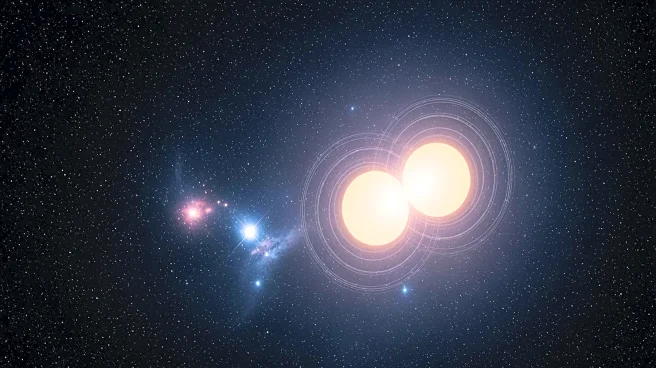
An international team of astronomers, including researchers from The University of Hong Kong, has discovered that some fast radio bursts (FRBs) originate from binary star systems. Using the Five-hundred-meter Aperture Spherical Telescope (FAST), they
observed a repeating FRB approximately 2.5 billion light-years away and detected a signal flare indicating the presence of a companion star. This finding challenges previous assumptions that FRBs come from isolated stars, suggesting instead that interactions within binary systems, particularly involving magnetars, are responsible for these cosmic phenomena.
Why It's Important?
This discovery significantly advances the understanding of fast radio bursts, which are among the most mysterious phenomena in astrophysics. By identifying binary systems as a source, the research opens new avenues for studying the conditions that lead to FRBs. The findings could reshape theoretical models and enhance the ability to predict and analyze these bursts, contributing to broader astrophysical knowledge. The involvement of international research teams and advanced telescopes like FAST underscores the collaborative nature of modern astronomical research.
What's Next?
Continued monitoring of FRBs using telescopes like FAST and Parkes will be crucial in confirming the prevalence of binary systems among FRB sources. Further research may focus on identifying more such systems and understanding the specific interactions that lead to FRBs. This could involve detailed studies of magnetars and their companion stars, potentially leading to new insights into stellar evolution and cosmic magnetism.