



What's Happening?
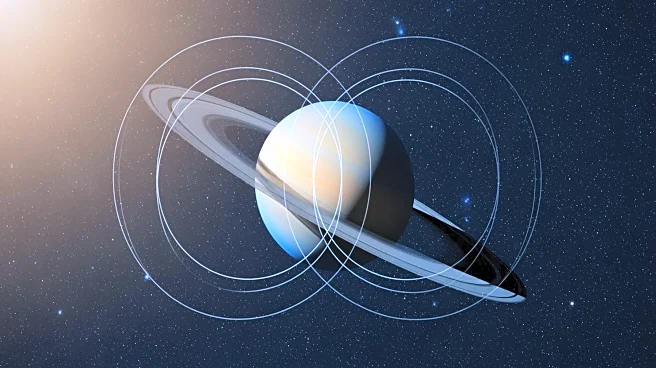
NASA's James Webb Space Telescope and Hubble Space Telescope have teamed up to capture new views of Saturn, revealing the planet in strikingly different ways. Observing in complementary wavelengths of light, the two space observatories provide scientists
with a richer, more layered understanding of the gas giant's atmosphere. Hubble reveals subtle color variations across the planet, while Webb's infrared view senses clouds and chemicals at many different depths in the atmosphere. The collaboration allows scientists to effectively 'slice' through Saturn's atmosphere at multiple altitudes, enhancing the understanding of its atmospheric dynamics.
Why It's Important?
The collaboration between Webb and Hubble is significant as it combines the strengths of both telescopes to provide a more comprehensive understanding of Saturn's atmosphere. This joint effort enhances the ability to track atmospheric changes, storm evolution, and seasonal shifts with greater precision. The insights gained from these observations can improve the understanding of fluid dynamics under extreme conditions, which is crucial for planetary science. Additionally, the data contributes to the long-term record of Saturn's atmospheric behavior, aiding in the study of its seasonal cycles and atmospheric processes.
What's Next?
As Saturn transitions into southern spring and later southern summer, Webb and Hubble will have progressively better views of its southern hemisphere. The ongoing observations will continue to build on the existing dataset, offering a broader, multiwavelength perspective as the planet progresses toward its next equinox. This will allow scientists to further explore the dynamics of Saturn's atmosphere and rings, providing valuable insights into the planet's behavior over time.
Beyond the Headlines
The collaboration between Webb and Hubble highlights the importance of integrating multiple observatories to construct a complete picture of planetary behavior. By combining Webb's infrared sensitivity with Hubble's visible-light record, scientists can gain a deeper understanding of Saturn's atmospheric structure and dynamic processes. This approach underscores the value of international cooperation in advancing space science and enhancing the study of our solar system.